We’ve seen it before: the tale of a Christian disillusioned with evangelicalism and its culture of exclusion. What we are still learning, however, is the assuredness with which Christian communities will shun one of their own—even one of their most skilled artists.
Jason Ikeler’s new documentary Safe for the Whole Family: How to Make a Christian Superstar, which premiered Sept. 27 at the Nashville Film Festival, offers history and commentary on Contemporary Christian Music from authors and scholars including Leah Payne, Jane Hong, and Kristin Kobes du Mez. The film focuses on artists Jennifer Knapp, Nikki Leonti, and Michael Passons as they revisit their rise in the Christian music industry—and the blows dealt to them on their way out of evangelical spaces.
Knapp is a Grammy-nominated singer-songwriter who commands the stage with her guitar and rich vocals. From the beginning, Knapp was perceived as a different kind of singer. Her song “Undo Me” was the standout track of WOW 1999, the Christian answer to NOW That’s What I Call Music!, launching her to the Dove Awards stage the next year to accept the New Artist of the Year award.
Nikki Leonti’s song “Everlasting Place” from her 1998 Christian pop album Shelter Me reached the top of CCM’s Adult Contemporary chart. Leonti’s push into Christian music came from her family. “Having a thought outside of that was never there because my dad’s like, ‘Your voice means nothing, what you do means nothing, unless it’s for the purpose of winning souls to Jesus,’” she explains in the film.
Michael Passons was a member of the Christian pop vocal quartet Avalon, known for their hit song “Testify to Love.” Sparrow Records (a Christian label) had wanted a group that looked like ABBA, and Passons was the first of four to fill it. In 2003, Avalon won the American Music Award for favorite contemporary inspirational artist.
READ: A ’90s Christian Hit Song Is Now Blooming as a Queer Anthem
Chanel Haynes, who was the lead singer of girl group Trin-i-tee 5:7, is a secondary voice in the film. Otherwise, there’s not much here about Black musicians who have contributed to CCM and modern gospel music, like Andraé Crouch, Kirk Franklin, Lecrae, or Mandisa. More representation of artists of color would have bolstered the film’s evident cause of a more inclusive world for faith and art.
Safe for the Whole Family diverges from 2021’s The Jesus Music, a documentary directed by Christian sibling filmmakers Jon and Andrew Erwin, produced in association with K-LOVE Films. The Jesus Music surveyed developments in Christian music from the Jesus People of the 1960s to modern CCM and praise and worship artists. The film has a largely positive slant and doesn’t delve fully into why some of its movers and shakers were ousted.
In contrast, Safe for the Whole Family lets the viewer sit with the heartbreak CCM’s artists and authority figures caused their colleagues.
The film focuses on artists Jennifer Knapp, Nikki Leonti, and Michael Passons as they revisit their rise in the Christian music industry—and the blows dealt to them on their way out of evangelical spaces.
Leonti describes her history with former Christian rock musician Ryan Gingerich, who she says she began a romantic relationship with when she was 17 and he was 22. Gingerich exposed himself and pressured Leonti into having sex, she alleges. “I remember when he took my virginity, it was consensual in that I laid there and I didn’t say no. But I wasn’t a mutual [participant]. … And then I hated myself more than anything because I didn’t have the strength to say no to what I didn’t want to do,” she says. Leonti was ostracized for having sex and becoming pregnant.
Once Passons realized he was gay, he adopted a conservative Christian stance on homosexuality and refrained from dating, but rumors started anyway. The other three members of Avalon ambushed Passons in his own house and kicked him out of the band for being gay, based on the rumors. Passons suffered from PTSD after his forced departure from CCM.
“There was a moment there where I was homeless. … I feel like they were all cannibals. I was just eaten alive and my bones thrown off the bus and the bus kept going, and nobody really looked back,” Passons says. If ever he would have died by suicide, he adds, it would have been during that time.
Knapp was the subject of rumors, as well. She learned that industry figures were “suspicious” that she was gay; they made assumptions and judged Knapp’s faith. “... I didn’t know I was breaking any kind of norms for what women were expected to look like. I don’t know. I just didn’t realize I was so, I guess maybe ‘butch’ might have been a way that I stood out, in that sense,” she says.
In the throes of success, signing CDs while on tour with DC Talk, Knapp seriously reconsidered the trajectory of her work. A fan whispered in Knapp’s ear, “Thank you; your music has saved me from a life of homosexuality,” then ran off. Knapp wishes she would have had the chance to say, “Run. Get out as fast as you can,” or, “You’re okay gay,” the artist explains in the film.
Knapp was not in agreement with the industry’s messaging about sexual purity, either. “What really are the consequences of this big propaganda machine that’s making tons of money?” she asked herself. Knapp “walked away from millions of dollars, at the time, because in that environment, it inherently requires you to keep toeing a line in order to succeed.”
CCM uplifted listeners of all ages with music that brought moments of joy and strength to many. But listeners and artists alike were only really accepted if they didn’t pop the Christian bubble and its made-up rules on everything from our media consumption to our bodily autonomy.
“Depicting secular music as dangerous, as harmful to your kids, was advantageous to Christian music labels who could make a lot of money by essentially creating a captive audience,” says Du Mez, who recently published Live Laugh Love: The Secret History of White Christian Women and the World They Made.
READ: ‘Live Laugh Love’ Untangles the Politics of White Christian Women
As anyone who grew up with CCM probably knows, it wasn’t so much a genre as a Christian-market counterpart to the secular music world, with artists and groups often positioned as faith-based alternatives to popular acts. Trin-i-tee 5:7 was in the vein of Destiny’s Child and TLC; Relient K was reminiscent of Blink-182; Plus One offered a Christian boy band alternative to the Backstreet Boys and NSYNC.
Safe for the Whole Family is not a comprehensive history of CCM. Rather, it’s a case study of what happened when Christian artists no longer fit the mold of the industry that profited from their work. “The word Christian, when applied to anything other than a human being, is a marketing term,” Derek Webb, formerly of Caedmon’s Call, poses.
To drill home the hypocrisy of imbuing a product with a religious identity, the film opens with a full-screen projection of Matthew 21:12-13: “Jesus entered the temple courts and drove out all who were buying and selling there. He overturned the tables of the money changers and the benches of those selling doves. ‘It is written,’ he said to them, ‘My house will be called a house of prayer, but you are making it a den of robbers.’” At its peak, CCM was nearly a $1 billion-per-year recording industry. Safe for the Whole Family isn’t unilaterally marking Christian music as a moral failing, but showing that CCM is a business, rather than a mission or ministry, and that its players cast aside artists they viewed as morally inferior (reading between the lines, artists who threatened profit margins).
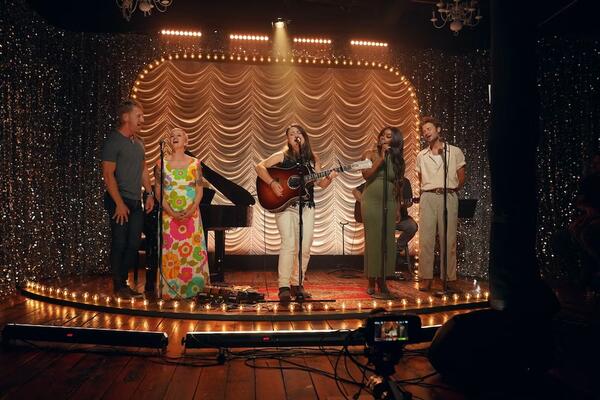
As the Virginia Film Festival adds Safe for the Whole Family to its October 25 lineup, artists and documentary interviewees Semler and Leigh Nash (formerly of Sixpence None the Richer) debuted an original song for the film, “Wanted.” They sing, “Faith will be found on the outside looking up.”
Leonti, Passons, and Knapp found faith and truth not within CCM but by leaving that world and the restrictions it placed on their lives and creativity: Leonti is now a critically acclaimed songwriter whose work can be heard in numerous film soundtracks; she has sung backing vocals for Demi Lovato, Nick Jonas, Jessie J, and many more. Passons collaborated with artist Ty Herndon and former Avalon member Melissa Greene (now an LGBTQ+ ally) to rerecord “Testify to Love” in May. His solo single, “Not Broken,” debuts this fall. Knapp completed a master’s degree in theological studies at Vanderbilt Divinity School in 2018. She released a rerecord of her studio debut album Kansas in 2024 and tours regularly.
CCM was never actually safe for the whole family; this documentary shows that inner safety is found in being who God made us to be.

Allison McClain Merrill is a freelance writer and reporter focusing on TV history, music, and faith and culture.
Did this article have an impact on you? Tell us how! Whether you’re moved to take action, have a question, or want to share a comment (good or bad), we value your feedback!