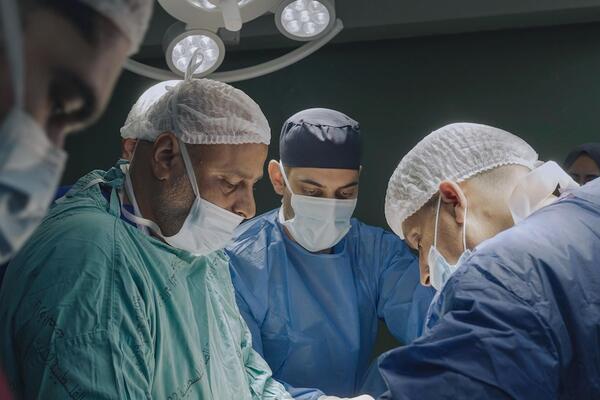
Director Poh Si Teng’s damning and incisive documentary, American Doctor, follows three American physicians and the medical work they do for those suffering in Gaza. The film chronicles the work of Jewish American orthopedic surgeon Dr. Mark Perlmutter, Palestinian American physician Dr. Thaer Ahmed, and Zoroastrian surgeon Dr. Feroze Sidhwa from Christmas 2024 to Christmas 2025, before and after the “so-called” 2025 ceasefire.
American Doctor acts as a testament to the resilience of the people of Gaza and an ode to the work of healthcare workers who travel to the most dangerous areas of the world to provide care. The film also showcases what happens once the doctors return to the States—their attempts at educating the American public about what Israel is doing to Gaza, and their tireless effort to raise awareness. Beautiful indeed are the feet of those who announce peace, and bring good news.
In The Message, Ta-Nehisi Coates observed that Israel’s systematic annihilation of the Palestinians “had the specific imprimatur of the United States of America.” In many ways, Teng’s film operates as proof of this idea: American Doctor documents U.S. atrocities abroad while also pointing to the ways they manifest back home. We are foolish to think, that the actions of the U.S. abroad would have no domestic consequences.
In a Zoom conversation with Teng, I asked her about why she chose to focus on medical professionals when documenting what’s going on in Gaza, how her Buddhist faith influenced the film, and how technology has transformed our ability to collectively bear witness.
This interview has been edited for length and clarity.
Zachary Lee, Sojourners: I’ve heard you say that American Doctor is like “The Pitt, but it’s real, and it’s set in Gaza.” Why do you think we’re drawn to medical shows?
Poh Si Teng: Everyone in their life will be in an ER, OR, or be in a medical facility and encounter doctors in their most vulnerable state at some point or another. If I were to embark on making a film like this, which is about the U.S. involvement in Gaza, I hope that it’s a film that can cut through all the noise and be something that can shift politics and culture.
So one has to use the available genres. I've held many different roles and jobs in the documentary film ecosystem. In my last job, I was an executive for a studio, and so if I put my creative, executive hat on, I think, “What does the landscape tell me?” The landscape tells me that healthcare is the largest single employer in the United States—if I remember correctly from when I did my research. So there’s an audience there, and it's important to move that audience, especially as it relates to healthcare workers in another part of the world in which our decisions, as Americans, have direct impact and consequences on them.
You have a Jewish, Palestinian, and Zoroastrian doctor working together here. I find that the film is beautiful not only for its ethnic unity, but for the religious backgrounds. I’m wondering if there were conversations with the three of you about how your respective faiths are influencing your work, or if you see a project like this as interfaith in a way?
As a verite filmmaker, one's role is to observe and steer a little bit, but it's also not to interfere. The verite filmmaking saying is that “you’re a fly on the wall.” That is incorrect. You’re a fly in the ointment; being in the mix. I was observing these three very good men, but they were so different. I don't think we had a conversation about interfaith and how that plays out. I was just wrapped in their individual worlds and the faith that they carried.
Malaysia is a very religiously diverse country. In my own family, we have Buddhists; we have Taoists. We live well together and support each other in the way we know how. I don't know whether we always have conversations about each other's faith.
I think what is striking is that regardless of the doctors’ religious backgrounds, they were guided by the belief in human dignity.
Everybody is on their own path to salvation, and there are many moments where we intersect and we meet and we help each other. I think that is at the heart of American Doctor.
I’m wondering if you find your own Buddhist faith challenged in making this film, or how you find it manifest in your creative practice for this project.
I think there are some principles that I try to adhere to, and I fail. Something that’s brought up a lot is that I spent $150,000 of my own money to jumpstart the funds for this project. It is a big thing, but it’s also not a big thing. In the Buddhist faith, it is very clear that to live life fully is to understand impermanence. Nothing is permanent. If you accept that and understand that, your life will be better because it teaches you not to hold on to what is painful and what is also pleasurable.
With American Doctor, yes, that was a test, and $150,000 is a significant amount of money I had set aside for my daughter’s future. I had to take this leap of faith that it was going to be worth it. I’m a true believer that when you give all, something good will come out of it, and there’s no halfway in.
READ MORE: What I Witnessed in Palestine Made Me Think About My Gun
In many ways, the Buddhist philosophy and way of living have helped guide me to discern what is important and what is not important. It is very easy in an American capitalist society to be confused about what’s important.
In cases like American Doctor and what’s happening in Gaza, it’s easy to lose sight of what’s important. My faith has grounded me to say, “Universally, we can all agree that children should not be killed by 2,000-pound bombs that are funded by the United States—by us.” Ultimately, it all comes back to: What is it I can live without? There are always ways to make money. What is it that I cannot live with? I cannot live with the fact that I didn’t try to do something. I thought back to myself, “Everybody has some power, everybody. I think it’s a cop out sometimes to think that one does not have power. There are moments where we are sad, we’re full of anguish, and it’s okay to take a break, but it’s also important to then come back to the work, to know that we all have some power here based on the relationships that we have, our lived experiences, our work experiences.
One thing that I’m really taken aback by is the honesty we see onscreen, particularly in how you’re not afraid to showcase people being upset at being filmed. I think of the scene in the Nasser Medical Complex, where we see footage of a nurse pushing the cameraman away—presumably cinematographer Ibrahim Al Otla.
Including those moments of tension is a testament to Ibrahim Al Otla and our co-producer Mohammed Sawwaf. We had full access to Nasser Medical Complex. As you can imagine, in a mass casualty event, children are being brought in; there’s pandemonium, there’s so much going on, and the ER doctor was just like, “I need to work on the situation. Why are you here?” I felt it was important to include that because we needed to show that situation and how there’s so much going on, and these doctors are trying their best to save lives. Our job is to not interfere.
If I think of myself as an audience member; I do want to know how it’s made. I do want to know a little bit about the filmmaker. I want to know a little bit about sausage-making. Because in a world where so much is not real with AI, misinformation, and disinformation, I want to know that this is legitimate. I want to know that there was some struggle and it wasn’t a shoo-in, that it wasn’t easy, and that the filmmakers grappled with something as they were making it. Because if the filmmaker has not grappled with it and has not learned anything, how can I, as an audience member, learn anything?
In the opening of this film, we see not just the atrocity of what’s unfolding, but the camera is capturing how people are recording those atrocities on their smartphones. How do you think media and technology have reshaped how people bear witness?
For that opening scene, when I remember when I saw it, the cameras, all the cell phones coming out—that indictment of us. The reason why that shot is an indictment of us is that the storytelling, the documentation, is left to the Palestinians on the ground in Gaza, and they are living through it as they have to document their own demise. That shot broke me. For those of us who have been paying attention, even with all of that, we’re able to turn away. Let us not turn away now. That’s why that shot is at the top of the film. We have to tell the story of Palestinians and see them as we see ourselves.
In Perfect Victims, poet Mohammed El-Kurd writes how “Palestine is a microcosm of the world … The lens we lend the Palestinian reveals how we see each other, how we see everything else.” Can you speak more to the importance of showing the humanity of people in Palestine, not just by showing the bodies of those murdered, but by emphasizing the humor and camaraderie that’s clearly evident there?
I don’t think I’ve talked so much about my faith anywhere, but it is my faith that I feel like has led me to see both and hold both at the same time. To live just the way I was raised, my understanding of life is that to live is to suffer, but it is also to love and to laugh. The very essence of life is to not shy away from or run away from either one, and to not hold onto it also because they will come and they will go.
“I cannot live with the fact that I didn’t try to do something.” —Poh Si Teng, filmmaker
Zachary Lee is a former online editorial assistant at Sojourners and part of the inaugural Sojourners Journalism Cohort. You can find him on Letterboxd @zlee729.
Did this article have an impact on you? Tell us how! Whether you’re moved to take action, have a question, or want to share a comment (good or bad), we value your feedback!