Arts & Culture

On Nov. 20, the Pauli Murray Center for History and Social Justice installed an altar on the steps of Murray’s childhood home in Durham, N.C. to celebrate the birthday of American civil rights leader and Episcopal priest Pauli Murray and Transgender Day of Remembrance.

Something terrible happened as I read Jason Zengerle’s Hated by All the Right People:Tucker Carlson and the Unraveling of the Conservative Mind. Some way through the searing biography of the conservative journalist, I remembered that Carlson is my enemy, that I’m a Christian, and that I have to love my enemies. And I quite enjoyed hating Tucker Carlson.

On the surface, Romanian director Cristian Mungiu’s film Fjord feels engineered for controversy and misunderstanding.
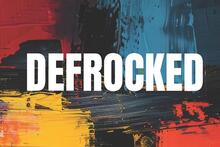
Minister and author Rev. Lillian Daniel recently published a memoir about a difficult period in her life. Defrocked: Good News from a Bad Pastor for a Better Church recounts Daniel’s journey through a ministerial fitness review conducted roughly a decade ago, following a sexual boundary violation she committed with a church employee during her senior pastorate.
Daniel’s creative reflections on the wonders and travails of ministry have helped define the modern landscape of mainline Protestantism. Her writing in Defrocked is characteristically clever, winsome, and charming. The book is laugh-out-loud funny at times and genuinely tear-jerking at others. There are mirthful, unguarded moments and recurring inside jokes, many involving alcohol, little winks between the author and reader that make you feel privy to secret knowledge. The prose is breathtaking: elegiac, disarming, self-aware, rippling with exegetical wisdom and authenticity. That the tale is narrated by such a talented storyteller makes the book’s omissions all the more maddening.
Faith Across Divides
The Across the Divide podcast highlights Palestinian Christians and the impacts Zionism has on their lives. Co-host Daniel Bannoura, a Palestinian theologian, interviews theologians and activists who share historical and spiritual insights along with ways Palestinian, Jewish, and U.S. Christians can build solidarity. Bethlehem Institute for Peace and Justice

i have been eighteen for four years now which means I am
paying off time i was never meant to have. my mother says
i was born as the sun neared its vertex, weeks before due,

I ARRIVED IN America with broken pieces of a past life. At 18, I immigrated with my family from the Philippines to the country my mother had spent decades praying we would reach. All I had were two large suitcases and a carry-on when we landed in a rural town nestled among Midwestern corn fields. The rupture of the self was bright and painful. Like Lot’s wife, I looked back at the fleeting ghost of home.
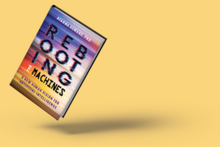
THE INDUSTRIAL REVOLUTION taught society that automation would redefine our relationships with each other and the world. If some Pandora’s box of artificial intelligence opens another technological revolution, we have the potential to have life overhauled yet again.

ALMA THOMAS WAS 80 in 1972 when she painted “Starry Night and the Astronauts.” Her thick inky blue vertical lines up and down the canvas leave just enough gaps of white space to create a glistening sky.
Witnessing the era of space exploration through color television “set my creativity in motion,” Thomas said in an artist statement.

As a queer person raised in Catholic purity culture, I’ve found horror films to be a vital way to confront and heal from my religious trauma.
IN AN ARTICLE earlier this year, Sojourners’ Tyler Huckabee astutely observed that, contrary to the way forgiveness is often considered in public discourse (“forgive and forget”), true forgiveness doesn’t mean operating as if harm never happened. If someone seeks forgiveness, they must admit causing hurt. If someone forgives someone else, it’s reasonable to assume their relationship to the person who hurt them won’t return to the way it was.
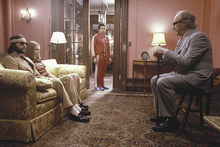
For an example of how forgiveness actually operates, consider director Wes Anderson’s The Royal Tenenbaums, released 25 years ago this month.

RIGHT FROM THE beginning, the Bible introduces readers to a God interested in physical things. Before God got to work creating, Genesis tells us, the Earth was “formless and empty” (1:2). God creates the land and the sea and covers it with plants and animals. The creation story tells us God formed humans and made us in the image and likeness of the divine.
It’s unsurprising then that humans have always wanted to ascribe a form to God’s being. In Exodus 33:18, Moses asks to see God, perhaps still shaken by the Israelites setting up a visible “god” of their own just a chapter before. In more recent times, translation choices, gendered assumptions, and age-old confusion about what power looks like have all influenced common depic-tions of God. Amy Kenny has been labeled blasphemous for promoting her own depiction of God as disabled. It’s a bold idea, and one that she doubles down on in her most recent book, My Disability Is Divine.
In Acts 5, the gospel writer Luke recounts the story of Ananias and Sapphira: a husband and wife who made a show of graciously donating the entire sum of a sale to the early church and the poor among them, all while secretly conspiring to keep a portion for themselves. The apostle Peter, prophetically seeing through the couple’s deception with total clarity, tells them, “You have not lied just to human beings, but to God.” In mere moments, both suddenly fall dead.
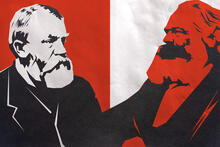
American evangelicals have long made a bogeyman out of Marx and his many inheritors. In 1952, Billy Graham made “Americanism”—his counter to communism—a central message of his crusades. Of course, this opposition finds its context in both the Cold War and evangelicals’ existing alliance with free-market capitalism.
The latest installment of this criticism comes from former Moody Church pastor Erwin W. Lutzer and former Moody Bible Institute professor Gregg Quiggle: Marx and Moody, published by Moody Publishers in September. Marx and Moody is broken into two clear sections. The first is written by Lutzer, and it primarily deals with Marx. The second is written by Quiggle, and it engages the life and social activism of Moody.
From the outset, the authors make clear their position: This is not a neutral, objective, or academic comparative study of two figures who helped shape their respective disciplines. It is a plea for readers to choose light over darkness, good over evil, Moody over Marx.

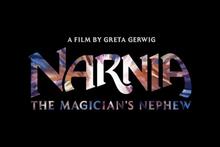
Narnia fans can rest easy. That was my thought upon leaving a sneak peek at Greta Gerwig’s upcoming Narnia adaptation.
The daily wisdom our algorithms invite Christians to practice on the Internet: Always judge a book by its cover. Be the first to cast stones. Condemn things we haven’t seen and know little about.

When I published a spiritual memoir based on the teachings of a 16th-century saint named Teresa of Avila, my 13-year-old daughter suggested my next writing project should be something “more people would want to read.”

‘Dear Maria’
“They’re playing God in space and giving bullets to the children,” Joy Oladokun sings before asking “Maria” to pray for “those shut down by history” and “burnt-out and suffering.”
I LEARNED HOW to build a fire from watching you. Thirteen years ago, in the living room of the Denver Catholic Worker on Welton Street, you’d fill the wood stove with kindling, loosely rolled newspaper, a few logs. Along with a carefully scaffolded collection of the right materials leaning on each other, you also needed patience. You needed to be calm. Steady.
It’s almost one year since your death. At a writing residency in the Adirondacks, I remember how the fire kept you busy. Another writer pauses from her work, carefully places a couple of logs into the fireplace; soon the flames swell, flicker.
Michelle, was tending the fire a distraction from the silence—or from the internal noise, the fire raging inside of you? I have so many questions I never got to ask—questions I likely never would have asked when you were alive. I never knew what hidden wound I might be pressing on with them.
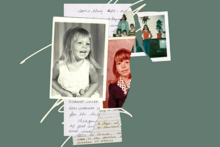
Instead, I’ve been looking through the letters you sent me over the years.
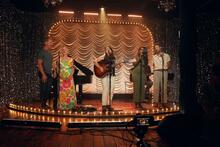
We’ve seen it before: the tale of a Christian disillusioned with evangelicalism and its culture of exclusion. What we are still learning, however, is the assuredness with which Christian communities will shun one of their own—even one of their most skilled artists.
Jason Ikeler’s new documentary Safe for the Whole Family: How to Make a Christian Superstar, which premiered Sept. 27 at the Nashville Film Festival, offers history and commentary on Contemporary Christian Music from authors and scholars including Leah Payne, Jane Hong, and Kristin Kobes du Mez. The film focuses on artists Jennifer Knapp, Nikki Leonti, and Michael Passons as they revisit their rise in the Christian music industry—and the blows dealt to them on their way out of evangelical spaces.