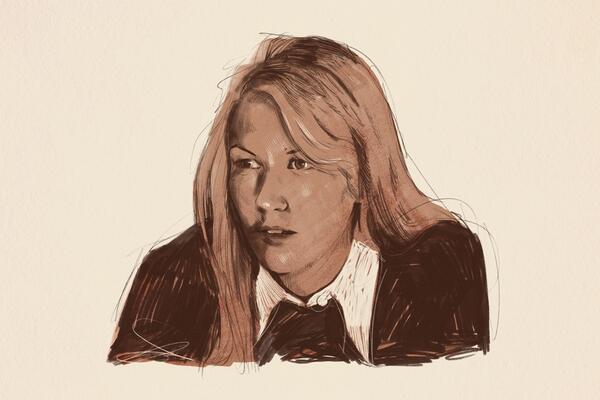
Annie Dillard, one of the greatest American writers, considered her own first book on writing a failure. At least, she called it “dull” and told an interviewer that she “never should have published it.” Perhaps I am perverse, then, in finding Living by Fiction (1982) at least as lovable, at least as profound, at least as essential to my own living and making as all her other work. At one point in that book, in a chapter called “Contemporary Prose Styles”—a chapter that I wouldn’t dare teach intro-level creative writing without—she writes:
Let me add this. You know how a puppy, when you point off in one direction for him, looks at your hand. It is hard to train him not to. The modernist arts in this century have gone to a great deal of trouble to untrain us readers, to force us to look at the hand. Contemporary modernist fine prose says, Look at my hand. Plain prose says, Look over there. But these are matters of emphasis. So long as words refer, the literary arts will continue to do two things at once … They point to the world with a hand. So long as you write literature, you cannot unhinge the world from the words, nor the words from the page.
It is such a characteristic paragraph of Dillard’s, who died this week at the age of 81. It contains at least one insight that, thoroughly pondered, could save you several months’ or even years’ worth of intellectual stumbling and hesitation, a verb (“you cannot unhinge”) that startles you with its precision, and a “puppy.” Not a dog, and not a specific breed: she knew that she needed a slightly comic word here, in the midst of all her “unlicensed metaphysics in a teacup” (as she describes the book in an earlier chapter), a word that alliterates with itself and invites readers to smack their lips over it, a word that has a little -ie at the end like a cute wagging tail. Also, the whole conceit—the contrast between looking at the hand, and looking at the thing it points to—may just be a highbrow riff on something Bruce Lee said in Enter the Dragon.
She had two great themes: seeing and suffering. Pilgrim at Tinker Creek (1974), her first nonfiction work and the book that more or less inspired the creation of the category “creative nonfiction,” hits the reader with both, pretty much immediately. No sooner has she demonstrated her talent for lush natural description than she puts it to use describing the Cronenbergian horror of a water bug sucking out the liquefied insides of a paralyzed frog. If you’ve ever taken a single creative nonfiction class, you know the passage already, but let’s say it together, like a Bible verse:
He was a very small frog with wide, dull eyes. And just as I looked at him, he slowly crumpled and began to sag. The spirit vanished from his eyes as if snuffed. His skin emptied and drooped; his very skull seemed to collapse and settle like a kicked tent. He was shrinking before my eyes like a deflating football.
You will never get that image out of your head.
An equally famous Dillard sentence begins her follow-up, Holy the Firm (1977): “Every day is a god, each day is a god.” Dillard so loves the world that, even here, in the phase of her work where she sticks closest to orthodox Christianity, she’s happy to risk a little polytheist idolatry. But then, as she describes her rustic idyll in Puget Sound, one of the gods of the day smacks an airplane out the sky and hideously burns a little girl’s face, and this daybook of lyrical praise becomes, again, a meditation on the problem of evil. For the Time Being (1999), published as the ordered madness of the 20th century hinged (or unhinged) into the neoliberal chaos of the 21st is probably her deepest meditation on that problem, a question that we are forbidden or unable, in this life, to do more than restate with greater precision or amplitude. Those three books will be read as long as we’re still asking it.
Nowhere in her work does she take refuge from the pitiless details of suffering in the idea of some great historical scheme, some engine of progress in which misery is the fuel. Her flirtation with the thought of Teilhard de Chardin in For the Time Being is as close as she gets to that sort of complacent Hegelianism.
She never stops thinking about the pain of the burned child. But she never longs to return to the Garden, either. In her largely silent final decades—she mostly ceased to publish after The Maytrees (2007), and told a pair of interviewers that that book and Time Being were “as high as I could go”—she painted and read, but she also wrote a letter defending wind farms against her fellow conservationists, who were afflicted with the usual NIMBY apprehensions about these hulking new entities on the landscape:
Wind farms are beautiful. Silently they witness the winds. Their motion adds value and beauty, as sailboats and kites do. Their fixed bases bespeak fidelity and acceptance, as windmills do.
Plastic. Sweaters. Wind farms. Deflated footballs. Ping-pong. B-movies. (Her dad had a bit part in Night of the Living Dead.) Suffering, and glory. Whatever all of this is, we have to see it through. And so for me her greatest works are the ones where she simply looks at things and tells us about them. Teaching a Stone to Talk (1982), perhaps the greatest essay collection of the past half-century, is such a series of well-wrought visions: total eclipses, burned deer, Galapagos turtles, Dillard’s crazy island neighbors. Living by Fiction is a series of well-wrought readings of modernist and postmodernist (“contemporary modernist” is the term she prefers) authors, i.e., it’s a nature book but with paragraphs and sentences as the specimens instead of leaves or bugs. An American Childhood (1987) started out as a massive history of Pittsburgh and ended up as a loving, but not nostalgic, look at a long-gone world, which happens to have been hers.
“Nature writer,” “transcendentalist,” “mystic”: We’re going to see these words a lot as Dillard’s fellow writers turn to the task of eulogizing her. Yes, Dillard was all these things. And a conservationist, a novelist, a great ping-pong player, a funnier writer as measured by laughs-per-page than any professional humorist I have ever heard of, a religiously eclectic skeptic, a poet of the erotic (go read The Maytrees if you doubt me). Famously, she met and married her third husband Robert Richardson—not her only love but, as one journalist would call it, her “big love”—after she sent him a fan letter about his biography of Thoreau. He followed up that book with biographies of Emerson and William James, as well as a shorter one of Dillard herself.
Yes, she loved the Transcendentalists, and she kept such faith with them that we can credit her with reviving the school. But she was a Transcendentalist to whom the 20th century had happened. You can imagine her watching Enter the Dragon and clapping, laughing at the high kicks. Her nature poems had plastic in them, and not just so that she could curse the ravages of industry. “Of course you’ve all heard/that the animals talk/at midnight,” begins 1973’s “Feast Days: Christmas”:
That the soil and freshwater lakes
also rejoice,
as do products
such as sweaters
(nor are plastics excluded
from grace),
is less well known.
She called herself a “gregarious recluse,” but there was in her single-mindedness no retreat from the world. She had simply found her place in it, and through luck and privilege (which is also, finally, at the individual level, just luck), been allowed to stay there. How few people get that opportunity! The Annie Dillard who celebrated her mother, in An American Childhood, for teaching her daughters to hate bullies and withstand oppressors, the Annie Dillard who mourned and memorialized anti-Chinese violence in The Living (1992) and who asked, in her great essay on the Book of Luke, why Christian churchgoers have so much money, would not want us to forget that everybody deserved the opportunities she got. But also: nobody else would have made of them what Annie Dillard did. Whether you looked at the hand, or at the things it pointed to, she shone.
[Annie Dillard] never stops thinking about the pain of the burned child. But she never longs to return to the Garden, either.
Did this article have an impact on you? Tell us how! Whether you’re moved to take action, have a question, or want to share a comment (good or bad), we value your feedback!