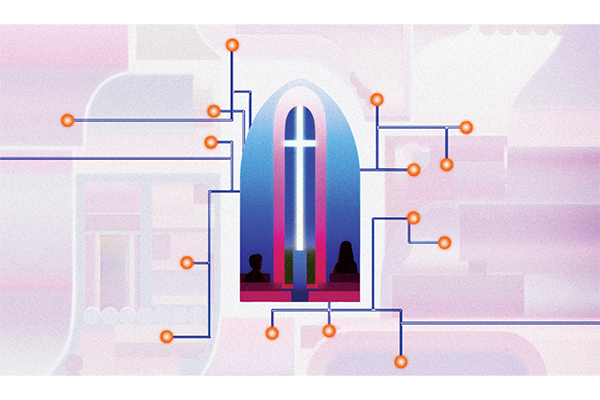
REP. JOHN LEWIS, in a 2012 conversation with a Comcast executive, said, “Access to the internet … is the civil rights issue of the 21st century.” That year, artificial intelligence was mainly confined to university research. Today, though still unprofitable, AI is embedded in all our internet systems.
Our digital divide continues to grow, and Lewis’ words continue to ring true. Inequity grows in our schools when kids lack access to reliable broadband. It grows in our low-income communities, where underfunded infrastructure maintenance means the misstep of a squirrel can shut down access for an entire neighborhood.
This divide is also growing in our churches—our community anchors—when we assume parishioners have reliable digital access. According to the State of Church Tech 2024 report, 91% of churches were livestreaming their services by 2024, but the survey did not ask who was being left behind. We design our ministries for the people who can connect with us every week, but what about the people who cannot? Sometimes, our churches move too quickly with technology, leaving others without support. We build systems that work for the well-connected but further isolate the already marginalized.
Why should the church wrestle with this disparity in digital access? Because it reveals what we, the body of Christ, have inherited from the society. The digital divide perpetuates and escalates biases that have long plagued this nation: Access leads to belonging and lack of access leads to disenfranchisement. Ruha Benjamin, author of Race After Technology: Abolitionist Tools for the New Jim Code, explains how inequity is engineered into the foundation of our digital infrastructure because technology reflects the values of the systems that build it. These embedded biases extend beyond individuals to whole systems, according to Benjamin, and to what historical data is put into data sets for machines to learn.
We build systems that work for the well-connected but further isolate the already marginalized.
If digital inequity can be engineered into our internet world, then digital equity can be woven intentionally into the infrastructure of our faith communities. For this, we must adopt a good theology of technology. And if theology informs practice, then what the church believes about God and how God wants us to use technology—not just to spread the gospel, but for the advancement of God’s people—matters.
A theology of technology values digital tools without sacrificing accessibility and belonging. If the gospel is about inclusion, belonging, and enfranchisement, then how the church integrates technology must reflect that. For example, does our church cultivate digital ministries that intentionally and preferentially serve marginalized communities—especially people with disabilities, homebound members, low-income families, geographically marginalized members, and senior citizens?
One starting place is to lead a digital accessibility audit of parishioners and those who live nearest the church building (who might use the church during an emergency). Black Churches 4 Digital Equity has helped churches use the Affordable Connectivity Program and low-cost internet services to strengthen digital access for low-income households. (ACP was federally funded in 2021 but not renewed in 2024.) Inclusion means adapting our systems, not asking people to catch up.
Digital access is not a luxury; it’s a matter of belonging. If the digital divide is bad news, then good news looks like the church offering training that helps remove the anxiety and fear surrounding adaptation to unfolding technologies. Good news looks like designing ministries with the least connected in mind. Good news means examining our digital ministries to make sure we are not replicating exclusion. It’s time to envision our churches sitting alongside Jesus at the “tech bar,” refusing to leave anyone behind.

Stacy Dandridge, a fellow with Black Churches 4 Equity, is pastor of digital ministry and technology at Christ Missionary Baptist Church in Memphis, Tenn.

Did this article have an impact on you? Tell us how! Whether you’re moved to take action, have a question, or want to share a comment (good or bad), we value your feedback!