In Acts 5, the gospel writer Luke recounts the story of Ananias and Sapphira: a husband and wife who made a show of graciously donating the entire sum of a sale to the early church and the poor among them, all while secretly conspiring to keep a portion for themselves. The apostle Peter, prophetically seeing through the couple’s deception with total clarity, tells them, “You have not lied just to human beings, but to God.” In mere moments, both suddenly fall dead.
It’s long been an enigmatic story in the history of the early church; when I was a child, the whole thing seemed overly judgmental and harsh. Surrounded by the flagrant corruption of the world today, however, some parts of the story have become more cogent to me: God exacting justice against those who would performatively weaponize a noble cause to fit their own greed; the human ability to absorb our own lies so readily that we think we’ve even convinced God that they’re true; the refreshing power of the Holy Spirit to see straight through such self-delusion.
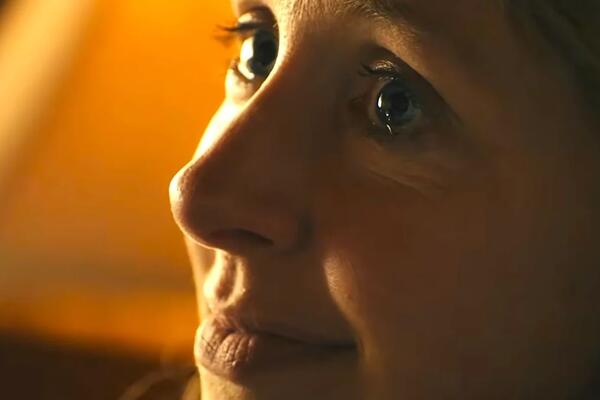
It’s this kind of prophetic moral clarity and undeniable truth that the viewer yearns to witness while watching Nathan Fielder and Lance Oppenheim’s You Can See Everything. The documentary, which follows Fielder as he’s invited to intimately document Elizabeth Holmes’ final month before going to prison, feels rife in every frame with distrust and dubious motives. Fielder, trying to understand Holmes’ psyche, seems unable to prevent himself from being pulled into the whirlpool of unreality and self-doubt she emanates. Over time, the viewer begins to suspect that her intentions may be part and parcel with her partner Billy’s, and money is a shady culprit. In moments, Fielder attempts to bring the clarity and incisiveness that Peter brought to Ananias and Sapphira—but he quickly finds himself beset with experiences that muddy the waters.
You Can See Everything is not the kind of movie that inspires a widely agreed-upon consensus. Since seeing it last week, I’ve already read countless diametrically opposed interpretations of the film, and Fielder, and Holmes—and I’ve found many of them compelling in different ways. Some read Holmes as a genuinely misunderstood (and possibly neurodivergent) victim in the grips of a controlling partner. Others argue that she is intentionally weaponizing an image of naive white woman domesticity and victimhood to keep her hands clean. At the core, there is a question of conscious deception vs. self-delusion: Is Holmes playing 4D chess to garner public sympathy, or is she simply beyond the pale of distinguishing reality from her own fiction? Is she merely lying to human beings, or lying to God, too?
Even the people who made the movie found this to be a nearly impossible question to answer. Fielder said in an interview with WIRED:
“At the end of the day, I would have in my head what I thought was a very clear idea of what was happening, and [everyone else] would all have a different take on what actually happened. I was like, how is this possible? We’re all in this room experiencing this thing. We’re all witnessing something and having a different idea of what’s going on.”
It’s an interesting microcosm of our moment, where algorithmic social media bubbles and media echo chambers have seemingly led the country to a place where two sides can witness the exact same event and interpret it completely differently.
Just last week, President Donald Trump repeated something at a rally that he’s been saying regularly since the day his second term started: “We’re in the golden age of America. So, our nation is doing better now than ever before.” In the midst of Trump’s many self-aggrandizing fictions, one sometimes wonders: Does he really believe this? Has Trump himself been so sucked down a rabbit hole of pandering AI slop and yes-men that he is unaware of the realities of a declining economy and disintegrating world alliances? Or is he still playing the “deny, deny, deny” game—secretly knowing the harsh truth but refusing to admit any blame? Just like with Holmes, it’s a little hard to say for sure. Perhaps both can be true, and perhaps in practice it doesn’t even matter. But one also wonders how “truth” can ever be obtained—or collectively agreed upon—in the midst of such fragmentation.
READ MORE: Nathan Fielder’s Absurdly Profound Exploration of Forgiveness
There’s been a subtle-but-observable pivot point for documentaries—or documentary-like biopics—this year. From NAZA to Musk and even The Social Reckoning, many filmmakers have moved toward using the vehicle of cinema to reckon overtly with the grim facts of our current world. That’s nothing new for documentarians, obviously; An Inconvenient Truth just turned 20 years old. But something about these films conveys a particular determination to pierce through the fog of misinformation, agendas, and algorithms and underscore an unjust reality that has not been admitted or dealt with—whether an ongoing genocide or a social media company’s ill intent for us all. When I saw NAZA, I was harrowed by the overwhelming body of evidence for Israel’s horrific AI-powered system of mass killing and the passive indifference of the people who enabled it. I wanted everyone I knew to see the film because I felt that simply hearing these interviews would make the truth undeniable for them. And this was the intent of the documentary: to confront the viewer with an incontrovertible reality, even when the world around them feels so hard to parse.
In the midst of this, You Can See Everything is simultaneously thinking along the same lines, and much less self-assured about its conclusions. The story’s core conceit affirms that there is such a thing as truth, and that it is worth the struggle to search for it. But in the end, the film also leaves the viewer cripplingly aware that despite its title, and despite Fielder’s unfettered access to Holmes, it may never be truly possible to “see everything.” As a person of faith, I walked away feeling as though I had no choice but to place my hope and trust in the notion that God sees the truth that I cannot.
There’s a thin line between that humble trust, however, and a passive blind eye turned toward the realities we can grasp with effort and attentiveness. In the midst of our world’s foggy ‘post-truth’ landscape, I’ve known some people in recent years who have decided to completely tune out of current events—or the actions of the administration they voted for—because they felt overwhelmed by “agendas” and “misinformation” that meant they couldn’t believe any of it. The world around us might be hard to parse, and misinformation is real—but we cannot simply throw up our hands and say “what is truth?” like Pilate during the trial of Jesus in the book of John (18:38). To do so would be to live in our own form of spiritual self-delusion, lying to people and lying to God about what’s right before our eyes. Some truths can still be seen, and some must be, even when they are hard to stomach.
It’s very hopeful to me that You Can See Everything has been as wildly successful and resonant as it has already, and that a key part of its appeal seems to be talking about it with others. In my city of Nashville, lines have stretched around the block at The Belcourt Theatre, and crowds of people have lingered in the parking lot for nearly an hour after each showing just verbally processing what they’ve witnessed with their friends. A few days after the movie came out, my mom reached out to schedule a family FaceTime call to discuss it. A debrief felt necessary and cathartic.
I would have assumed that a movie about such a divisive and beguiling reality would simply be frustrating and off-putting for people living in a world surrounded by so many competing realities already. But the more I’ve sat with it, the more I think part of the film’s appeal is the way it offers an opportunity to wrestle some kind of common reality from its clutches, together in community and conversation with others. The audience for You Can See Everything was one of the most collectively reactive and engaged crowds I’ve experienced in theaters in a very long time, and something about it felt unifying and catalyzing. It told me that there is such a thing as truth, and that the other strangers in the theater were just as interested in finding it as I was.
Perhaps the shared reality we can agree upon right now is that we don’t always understand reality. We’ll never see everything, but together with each other—and with God’s help—we may see more than we ever could alone.
Fielder attempts to bring the clarity and incisiveness that Peter brought to Ananias and Sapphira—but he quickly finds himself beset with experiences that muddy the waters.

Georgia Coley is a documentary filmmaker and culture writer living in Nashville. She writes about the intersection of trans experience and theology at her Substack, Georgia In Her Mind.
Did this article have an impact on you? Tell us how! Whether you’re moved to take action, have a question, or want to share a comment (good or bad), we value your feedback!