In recent years, evangelical figureheads like Franklin Graham, Al Mohler, Mark Driscoll, and Josh Howerton have all engaged in fearmongering about an incoming socialist storm that threatens to swiftly wipe away traditional values and God-ordained government. As Democratic Socialists have garnered public support, their opponents’ criticism has gotten louder.
The fear of socialism, and its evolution into a dreadful, godless communist state, is not new. American evangelicals have long made a bogeyman out of Marx and his many inheritors. In 1952, Billy Graham made “Americanism”—his counter to communism—a central message of his crusades. Of course, this opposition finds its context in both the Cold War and evangelicals’ existing alliance with free-market capitalism.
The fear of socialism, and its evolution into a dreadful, godless communist state, is not new. American evangelicals have long made a bogeyman out of Marx and his many inheritors.
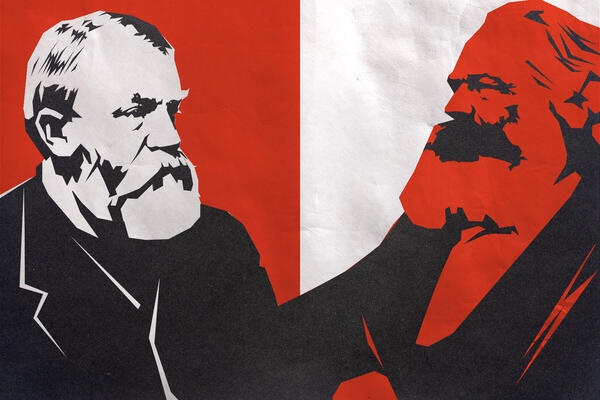
The latest installment of this criticism comes from former Moody Church pastor Erwin W. Lutzer and former Moody Bible Institute professor Gregg Quiggle: Marx and Moody, published by Moody Publishers in September. Marx and Moody is broken into two clear sections. The first is written by Lutzer, and it primarily deals with Marx. The second is written by Quiggle, and it engages the life and social activism of Moody.
From the outset, the authors make clear their position: This is not a neutral, objective, or academic comparative study of two figures who helped shape their respective disciplines. It is a plea for readers to choose light over darkness, good over evil, Moody over Marx.
The authors are upfront in naming their professional affiliations with and personal fondness for Dwight Lyman Moody. We (Amar and Yanan) both attended Moody Bible Institute, passing daily under the famous arch on LaSalle Drive inscribed with 2 Timothy 2:15, attending chapel in the Torrey-Gray Auditorium, and studying in the Sweeting Center for World Evangelization. We took courses with Quiggle and listened to Lutzer preach at chapels and school conferences. MBI was our introduction to the world of theology, providing us a lens through which to interpret the world around us as “a spiritual battleground.”
Despite this early theological formation, we both went in a different direction. Whether it was through the classroom or the activism of Democratic Socialists amid national protests against the Palestinian genocide, we each found our way to the philosophy of Karl Marx. While we have points of disagreement with Marx and with each other, we still consider ourselves leftists. Considering our familiarity with MBI, D.L. Moody, and Karl Marx, we are uniquely positioned to engage with Lutzer and Quiggle’s claims about Marx and Moody.
Moody
Quiggle’s account of Moody’s life, ministry, and social vision repeats much of what is written in his 2024 book Bread and Bibles: D. L. Moody’s Evangelism and Social Action (also Moody Publishers). It begins with Moody’s humble beginnings in Northfield, Mass., as the sixth of nine children. His home, stripped to its bones to pay his late father’s debt, was led by Moody’s prayerful mother. At 17, Moody moved to Boston in pursuit of wealth, where he worked for his uncle and converted to Christianity under the teachings of Edward Kimball. A few years later, he moved to Chicago to pursue greater wealth by selling shoes. Even while pursuing such wealth, Quiggle argues that “he never lost sight of the poor” despite doing “very well.”
In 1858, Moody founded an independent Sunday school on Chicago’s North Side, near the Chicago River. To describe the community it served, Quiggle cites an 1875 Chicago Tribune account of a neighborhood known as “Little Hell,” populated by “the poorest and most wretched class,” who were “the Communists who would like nothing better than to incite an open riot.” The problem here is that Little Hell was not Moody’s neighborhood. It took shape after the Great Fire of 1871 around relief shanties and a gas works west of Larrabee Street, all roughly a mile from the hall where Moody taught. Quiggle borrows the Tribune’s contemptuous portrait of the poor to anachronistically dramatize Moody’s mission and loosely connect it to Marx without first asking whose description it was or what it was for.
From Quiggle’s perspective, leading and teaching this Sunday school left “no confusion or struggle for Moody about his life’s call; the desire for business success was gone.” Moody became active with the Chicago Young Men’s Christian Association and, by 1866, was president of the organization. Under Moody’s leadership, the YMCA “expanded its efforts among Chicago’s working class.”
In 1875, Moody moved permanently to Northfield and opened several schools between his home and Chicago, including what would become MBI. Quiggle highlights the worker unrest in 1886 by quoting Moody’s own reflection on the situation: “Either these people are to be evangelized or the leaven of Communism and infidelity will assume such enormous proportions that it will break out in a reign of terror such as this country has never known.” From Moody’s perspective, MBI served to educate workers in the Christian gospel lest they fall into the trap of godless communism.
While Quiggle’s analysis of Moody is largely positive, he does concede that Moody was a complex and imperfect minister. He dedicates approximately one page to acknowledging that Moody segregated his revivals in the South, an action condemned by Civil Rights leaders such as Francis Grimke, Ida B. Wells, and (unmentioned by Quiggle) Frederick Douglass. Quiggle admits that Moody could have “said more earlier in his career” about “labor issues, working conditions, and racial issues.” However, instead of interrogating Moody’s complexities more deeply, Quiggle settles for a simplistic view of Moody and his works. The irony is that a Marxist analysis of Moody is precisely the analytical tool that provides explanatory power for these complexities.
In historian William R. Leach’s 1993 book Land of Desire, Leach, like Quiggle, explains that Moody moved to Chicago and “pursued a very profitable career as a shoe salesman.” Absent from Quiggle’s account, though, is an important point that Leach highlights: Moody “also speculated in real estate and made personal loans at usurious interest rates.” In other words, Moody was a loan shark. Leach concludes that for Moody, there was no contradiction “between his business behavior and his religion.”
It is undeniable that Moody did serve the poor in Chicago, but his alliance was ultimately with the economically and socially powerful. As his segregated revivals and anti-union actions demonstrate, Moody was unwilling to sacrifice these allegiances to truly stand on the side of the poor and oppressed.
This is ultimately the crucial flaw in Marx and Moody: The authors name Moody’s faults but fail to account for them and refuse to engage with any serious scholarship that counters their borderline hagiography. While Quiggle draws from personal research, primary sources, and archival materials, much of his story relies on evangelical biographers who are sympathetic to Moody’s cause. When he does cite more critical scholars—like Timothy Gloege and Edward Blum—it is only to support minor points about Moody’s life. There is not a substantive or systemic critique of Moody, which would befit a book analyzing Moody and Marx. Instead, Quiggle directs readers to his book Bread and Bibles.
Marx
Unlike Moody, the German-Jewish political philosopher Karl Marx is not a hero among evangelicals. For the late evangelist Billy Graham, Marx’s ideas constitute “Satan’s religion.” He warned about those who aligned themselves with Marx: “The Devil is their god, Marx their prophet[.]”
Lutzer—an evangelical pastor, broadcaster, and author—seems to agree. In Marx and Moody, he warns his readers that evangelicals must “put on the whole armor of God” in the struggle against Marxism, for it constitutes “not just a philosophical battle, but a battle waged against the ‘cosmic powers, over this present darkness.’”
Lutzer’s analysis of Marxist thought follows a familiar pattern for many evangelicals. Jesus proclaimed the true gospel of reconciliation and eternal life with God, while Marx preached a “worldly gospel” of class struggle that pitted the poor against the rich. Jesus led people to God by preaching the gospel, while Marx led people to hell by putting religion to death. After all, Marx once wrote that “religion is the opium of the people.” Worse, in an 1847 article for the Deutsche-Brüsseler-Zeitung, he wrote that “the social principles of Christianity justified the slavery of antiquity, glorified the serfdom of the Middle Ages and are capable, in case of need, of defending the oppression of the proletariat.”
It seems Marx was truly of the devil: an adversary to the gospel and Christianity.
For Lutzer, even the constructive principles of Marxism, or what he calls Marx’s “useful lies” and “hollow pillars,” are both morally sinful and politically ineffective in addressing the plight of the poor and working class. Primary are (1) the abolition of private property and (2) the idea that “faith in God must be transferred to the state.” For Lutzer, Marx was not only too idealistic but vile. While Marx argued the abolition of private property would lead to true equality, Lutzer argues that “[f]reedom and individuality will vanish in favor of the greater good of the collective.” The state would “control your economic decisions.” Hell, the state would have supreme authority over the individual’s life in such a way that no one would ever work for themselves but only “for the state.”
For Lutzer, this is why the state had to replace God in Marx’s imagination: “Marx didn’t just not believe in God, he hated God.” God was an obstacle to overcome in pursuit of Marxist equality. God had to be put to death alongside the capitalists so workers could seize the means of production and submit to the tyranny of a Marxist state. For Lutzer, Marx only heralded a godless society where tyranny abounds, and people have no freedom.
If Lutzer is right, then Christians must truly be ready to apostatize Marxism in service to God. But if Marx is as opposed to Christianity as Marx and Moody suggests, then why is it that many Christians across the world, especially in the Global South, not only tolerate Marx but use his ideas to advance the gospel of Jesus Christ?
The Peruvian priest Gustavo Gutiérrez, hailed as one of the founders of liberation theology, noted that Marxism wasn’t an opponent to the gospel. Indeed, Marx’s idea of class struggle is something Gutiérrez encourages Christians to embrace, for “[t]o deny the fact of class struggle is really to put oneself on the side of the dominant sectors.” For Gutiérrez, God calls Christians to a “Universal love” that stands “in solidarity with the oppressed” and seeks “to liberate the oppressors from their own power.” Around the same time, in the Philippines, the Catholic-led Christians for National Liberation emerged against the oppression of the U.S.-backed dictatorship. These Christians put what is called a “theology of struggle” into practice. These Christians saw God’s solidarity with the poor and downtrodden as something to emulate.
The heart of social rot in contexts where U.S. imperialism reigns is not Marxism or its political philosophy. Rather, it is capitalism and its endless drive for profit and power through exploitation and dispossession. It is this endless drive that undergirds both the Latin American and Philippine contexts, especially when sanctified by U.S. military-economic interests. This same drive for profit and power moved the Philippine dictator Ferdinand Marcos Sr., to deepen neocolonial relations with the U.S. and enforce martial law in pursuit of capitalist modernization that served him, siphoning an estimated $5 billion to $10 billion from the Filipino people into his own pockets. It is this endless drive for profit and power that spread across Latin America, from the CIA’s 1954 overthrow of Guatemala’s elected government, which had expropriated land from the U.S.-owned United Fruit Company, to the U.S. campaign to destabilize Chile’s elected government and its backing of the Pinochet dictatorship and its free-market experiment that followed.
Capitalism, especially U.S.-enforced capitalism, is what many of these Global South Christians have recognized as the ultimate material force against which the Christian struggle persists. In 1984, under the weight of racist violence in the U.S., the Black theologian James H. Cone wrote, “Marxism as a tool of social analysis can disclose the gap between appearance and reality, and thereby help Christians to see how things really are.”
Lutzer and Quiggle may scoff at this reading of Marx. But what many evangelical readers underestimate is how Marx’s philosophy was influenced by the Jewish tradition—specifically, the Hebrew prophets and the doctrine of creation’s wholeness. The psychoanalyst and social theorist Erich Fromm placed Marx squarely within what he called “prophetic Messianism,” or the prophets’ hope for a just social order realized within history. Fromm argues that “Marx’s aim was that of the spiritual emancipation of man, of his liberation from the chains of economic determination, of restituting him in his human wholeness, of enabling him to find unity and harmony with his fellow man and with nature.”
The authors of Marx and Moody recite the same tired trope about Marxist philosophy being antagonistic toward religion in general and Christianity specifically. But in reality, Marx’s relationship with religion is much more multifaceted than detractors present it. Some argue that Marx himself drew from theological language to make his claims. Marx’s criticism of religion was that it keeps the masses subservient to the interests of the powerful, acting as a “drug” that pacifies them into submission. Within this framework, Moody’s union-busting support can be seen as a form of pro-capitalist pacification in the way Marx puts it. In contrast to Moody, who actively tried to dissuade workers from participating in labor strikes, Marx recognized that religion pacified the masses, keeping them subservient.
From a historical perspective, it is true to say that the kind of Christianity that Moody demonstrates has served as a way to keep the poor and working class under oppressive powers. Indeed, this dominant version of Christianity has generated the very social ills we are facing today—from evangelical MAGA’s undying allegiance to Donald Trump to Christian Zionist affirmation of the state of Israel’s genocidal campaign against Palestinians.
Before Marx was Mary
Can Marx save us from sin? No. But neither can D.L. Moody.
Both are indeed human and finite like the rest of us. But if the question is which one of these men’s politics and philosophy can better aid the poor and oppressed, then the answer would be Marx.
Moody embraced segregation and supported union-busting. The school that Moody founded currently faces criticism for allegations of covering up sex abuse rather than protecting the courageous students who came forward. The endless drive for profit and power continues to be the backbone of the evangelical business that guarantees the “purity” of its products to evangelical consumers.
We must be clear that Marx’s legacy is also a complicated one, wherein Marx’s own ideas have been used to repress revolution and social transformation. Autocracies were established, claiming that they were implementing Marx’s ideals. In this way, we do agree with both Quiggle and Lutzer, who warn of the injustices perpetuated in the name of Marxism.
Yet Marx’s legacy goes beyond such injustices. Working people continue to see Marxism as the best means to achieve true democracy by implementing socialism. This is called Democratic Socialism. For Democratic Socialists, Marx’s ideas only work if they are won and run by the self-organized working-class majority through democratic institutions rather than imposed by elites or a party-state. The scholar Hal Draper identifies this movement as “socialism from below,” wherein liberation from capitalism can only truly be accomplished by the self-determination of the ordinary masses.
There is no thinker as precise and as developed as Karl Marx who has been able to name what is at the root of this oppressive system: capitalism. If we cannot identify it, then social movements can never be carefully organized to address the root cause. And as Christians called to pursue justice in our cities and neighborhoods, Marx helps identify this economic system of capitalism and encourages us to demand its abolition so that we might all be liberated.
Christians are called to pursue justice in our cities and neighborhoods; Marx helps identify this economic system of capitalism and encourages us to demand its abolition so that we might all be liberated.
Before Marx wrote about the ensuing revolution, Mary, the Mother of God, prophesied that there was a gospel coming that would address the material ills of domination and the spiritual rot within these structures (Luke 1:52-53). God demands a revolution not only of the heart but of the world.

Amar D. Peterman is an Indian American scholar working at the intersection of faith and public life. He is the author of Becoming Neighbors: The Common Good Made Local. You can learn more about his work at amarpeterman.com.

Yanan (or Abdul) is a theologian from the Philippines. He writes about Christian radical politics, and his writing has appeared in BitterSweet Monthly, Interfaith America, the Institute for Christian Socialism, and other outlets.
Did this article have an impact on you? Tell us how! Whether you’re moved to take action, have a question, or want to share a comment (good or bad), we value your feedback!