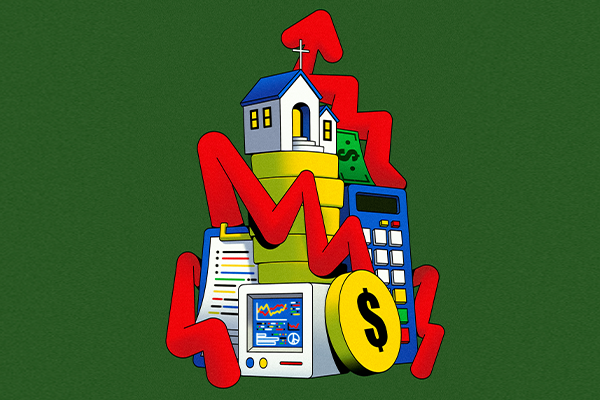
STEVE BROWN DESCRIBED Shiloh Missionary Baptist Church, the church where he had served as a trustee for many years, as being in “the poverty-stricken area of Daytona Beach [Florida]. We’re in the ’hood, in layman’s terms.”
When I drove to Daytona Beach in April 2024 to take pictures of Shiloh’s sanctuary, I continued past the church and into its neighborhood. As I headed toward train tracks that bear freight for the Florida East Coast Railway, I passed businesses and houses with bars on first-floor windows and air conditioners hanging out of upper-floor windows. A few people were taking shade under trees.
Trustee Brown had told me that Shiloh’s congregants were “financially strapped,” as they had been for most of the church’s 100-year history. But that doesn’t stop this church of more than 200 members from offering services to those in the area. According to Brown, each week its soup kitchen feeds between 70 and 100 people, a program that Shiloh continued during the COVID-19 pandemic, when it set up tables in the parking lot. “We didn’t want to stop it,” Brown said, “because a lot of people depend on” the church’s outreach.
Years earlier, in 2010 and again in 2018, Shiloh had filed bankruptcy under chapter 11 of the U.S. Bankruptcy Code, seeking to reorganize so it could remain operating, hopefully for decades to come. A chapter 11 case is also called a “reorganization” bankruptcy. It provides a path for an organization to restructure its debts and streamline operations to stay in business rather than closing due to debt problems.
Shiloh wasn’t the only church to have sought to reorganize. My research of court documents found that more than a thousand churches in the U.S. filed chapter 11 between 2006 and 2020. I learned from court documents about the financial state of the churches when entering bankruptcy, as well as about their history and operations—that is, what drove them to invoke the protection and power of bankruptcy courts and the reorganization process.
But court records provide only so many details. As a Missionary Baptist church, Shiloh comes from one of a handful of historically Black denominations. Looking through the filing churches’ names, I found that 1 in 6 were affiliated with such denominations. Predominantly Black congregations (defined by the National Congregations Study as having at least 80% Black members) that were independent churches or in denominations that are not majority Black had also filed. Nationwide, around 20% of all congregations have predominantly Black membership. Yet, more than 60% of the churches that sought chapter 11 reorganization in my research sample were Black churches. Year after year, something drove Black churches, much more than other churches, to bankruptcy courts. What was it?
Black churches play a crucial role in Black communities. Across times of political and civil unrest, Black churches have provided prominent places for Black people to come together. They continue to serve as anchors of economic development. And their buildings become physical representations of communities’ growth and success. The Black church also is a place where the community can house its money, growing equity in buildings.
The court records indicated that Black churches did not necessarily seem financially or operationally at fault, at least not more so than other churches. Factors outside Black churches’ control may have influenced their bankruptcy filings. The continual blocking of economic opportunity and growth through credit policies has shaped Black communities’ experiences. Like other businesses and families, churches need to take out credit to fund large purchases, such as buying a building for a house of worship. I could tell from court records that almost every church that filed bankruptcy did so in hopes of keeping its spiritual home. The churches’ buildings typically were in the midst of foreclosure proceedings or under threat of foreclosure when they filed. Invoking the reorganization process pauses foreclosure and, because of the bankruptcy law’s structure, forces lenders to negotiate.
Lenders may have extended loans with onerous terms to Black churches or may have been unyielding in negotiations when Black churches faced difficulties. Such behavior would have been consistent with the history of lending practices in the United States. According to many studies, Black people pay more for home loans, auto loans, student loans, and credit cards than white people, and traditional lenders are less likely to offer credit to Black people and Black-owned businesses. If such disparities didn’t exist in the church lending market, it would be an outlier, distinct from every other credit market. Such disparities may lead Black churches to turn to reorganization more often than other churches.
To find out more, I reached out to church leaders and the attorneys that helped churches with their reorganization cases. Over nearly a decade, I interviewed 48 leaders from churches and 86 attorneys who had represented 124 churches.
traditional lenders are less likely to offer Black people and Black-owned businesses credit.
When banks say ‘no’
ONE OF THOSE church leaders was Trustee Brown from Daytona’s Shiloh Missionary Baptist Church. At the time of its second bankruptcy, Brown was Shiloh’s finance chair, which put him in the position of overseeing the case. With a background in accounting and 30 years of public service working for the state of Florida under his belt, Brown had the knowledge to guide Shiloh through the process.
Before I spoke with Brown, I reviewed both of Shiloh’s reorganization cases. Shiloh seemed typical of the churches that had filed in the 14 years between 2006 and 2020. It was an established, smaller congregational church. By the early 2000s, its building had become so outdated that bringing it up to code would require more money than the congregation could hope to raise. Shiloh had approached mainstream banks to take out a traditional mortgage. Despite having more than a third of the requested loan amount for a down payment, all the banks turned Shiloh away.
Brown told me about the financing the church was able to secure. The lender was a financial company that put together a bond issuance for Shiloh. A bond issuance is a method of raising money typically used by larger businesses to pay for large projects, such as construction. Bonds are sold to investors. A church thus borrows from investors instead of from a regular bank. The terms of the bond are typically set by the financial company. Often church members buy some of the bonds. The terms often include additional fees, variable interest rates—which are often higher than standard bank loans—and monthly mortgage payments.
The bond issuance raised the money that allowed the church to build its new facility. Brown described it as “buy here/pay here” financing. “It allows [a church] to borrow more money than you realistically could afford,” Brown said, “based on [the prospect that] when you build a new church, your membership is going to dramatically increase.” In such a scenario, the loan seems to come with higher likelihood of defaulting, which is what happened in Shiloh’s case. Even though the new construction was completed, the church soon faced a financially untenable situation.
In 2010, according to Brown, Shiloh’s trustees convened a special meeting of the congregation’s members, which authorized the church to file bankruptcy. When it filed again in 2018, it listed its church building as worth $750,000 (almost $1 million in today’s dollars) and reported that it owned some property in the building—a sound system, pews, and furniture in the fellowship hall, vestibule, and offices—collectively worth about $50,000. Its only vehicle was a 1995 Ford van with more than 90,000 miles on it, worth around $1,000.
Through reorganization, Black churches found a way to fight back and survive.
Trips through reorganization
SHILOH'S NEW SANCTUARY—the building I visited in 2024—sits back from the street. The building’s off-white façade is adorned with a large white cross that frames the black double doors to its main entrance. A white steeple with another white cross tops its rusty red roof. The sanctuary’s manicured lawn and tidily trimmed bushes stood out in the neighborhood.
In addition to the main entrance, the building features a circular driveway and drop-off loop with two rows of precisely spaced palm trees leading the way to a secondary front entrance. I sat in my car in the large parking lot to the right of this entrance. It became increasingly apparent that I had arrived at a time no one was around. I stared for a bit at the wooden fence that surrounded most of Shiloh’s grounds, both welcoming visitors and demarking its grounds.
Shiloh’s first trip through reorganization came in the context of the Great Recession of 2008. But for Brown, it was the terms of the church’s loan to build the new sanctuary that made it hard to survive the global financial meltdown. Shiloh’s mortgage on the new building for the first year, Brown said, “was $6,000 [a month, and then] it was to progressively go up over the five-year period” of its term. “It put us in a position where the first couple years we were able to meet the $6,000. We were able to meet up to about $8,000 a month for the mortgage payment. Then, when it was time for it to escalate to about $10,000 [a month], we were not able to afford that.”
I heard similar stories of troubles with loans and lenders from other church leaders. Churches had been sold expensive loans—the equivalent of subprime home loans—to purchase, renovate, or expand buildings. Sometimes traditional lenders, such as mainstream banks, had turned churches away, leading them to approach financial institutions that would sell them more restrictive or riskier loans. Other churches turned to Christian-based lenders. These loans, too, often turned out to be expensive. Based on my interviews and my review of court records, more churches with onerous loans were Black.
When these churches faced financial hiccups, such as construction problems or the internal operational missteps that can plague all businesses, they were more likely to fall behind on loans. They reached out to their lenders for help. Lenders often turned them away and moved to foreclose on buildings, which would result in the loss of physical spaces and the equity the congregations had accumulated in those properties.
Foreclosure would result in the loss of pillars of the community and support for surrounding neighborhoods. Black church leaders and congregants knew this. Through reorganization, they found a way to fight back and survive.
According to Brown, Shiloh’s first trip through reorganization was not “advantageous” for the church, because the plan stipulated that—after a few years of interest-only payments on the bonds—the entire balance would come due. By then, the idea was for Shiloh to have lined up a new lender to refinance the loan. Brown thought Shiloh needed some principal reduction on the bonds, “but the church was adamant that [it] needed to pay what [it owed], and it’ll work itself out.”
But I consider Shiloh’s first reorganization a success. Negotiations with its lender had stalled. Shiloh could have lost its sanctuary to foreclosure. Reorganization resulted in a plan that allowed the congregation to stay in the building for years, plus a chance to find a new lender. Ultimately, though, they could not find a lending partner “that would finance the church in the ’hood with the membership and the income we had,” Brown said. “So, we had to file chapter 11 the second time.”
Shiloh’s second trip through reorganization was solely about dealing with the still too-expensive loan that accompanied its sanctuary. Brown successfully negotiated some principal reduction. It confirmed a similar plan to the previous reorganization. Shiloh would make interest-only payments for five years and then the bonds would come due. Except when they came due, Shiloh would only owe about $500,000, instead of the $1.3 million owed when it filed chapter 11 in 2018. This would make it much easier to find a new lender to refinance the loan. I also regard Shiloh’s second reorganization case as successful, since it allowed the congregation to stay in the sanctuary.
These outcomes echo the majority of the cases of churches that have filed to reorganize. More than half continue operating in their buildings, a success rate more than 50% higher than the estimated success rate of for-profit business reorganization cases.
Foreclosure would result in the loss of pillars of the community.
Increasing financial democracy
ALTHOUGH CHURCHES OF all demographics file bankruptcy to reorganize, Black churches do so more often. But their cases are quite successful in terms of the bankruptcy system. Black churches keep their communities together, keep their physical buildings, and often keep the equity in those buildings. Bankruptcy law and the reorganization process levels the playing field, bringing lenders to the negotiating table, as it did for Shiloh. Church leaders and congregants are wise to turn to chapter 11 in extreme situations. Still, they know that they are paying money and sacrificing time for these successes.
As it worked through two bankruptcy reorganizations, Shiloh held worship services and supported its community, as it continues to do today. It seems to have found a new lender to finance what remains of its mortgage. But based on my conversations and review of court records, many churches should have received better deals from lenders initially or when they asked for help in times of financial trouble rather than needing to turn to reorganization.
The church lending market deserves a rigorous review, as provided for in current federal and state laws. Increased financial democracy broadly will allow Black churches more financial autonomy. Until then, reorganization will remain one of the leading ways for Black churches to contend with predatory lenders and survive.

Pamela Foohey is the Curtis Bradbury Keller Professor of Law at the University of Minnesota Law School. She is the author of Forgive Us Our Debts: How Black Churches Use Bankruptcy to Survive.

Did this article have an impact on you? Tell us how! Whether you’re moved to take action, have a question, or want to share a comment (good or bad), we value your feedback!