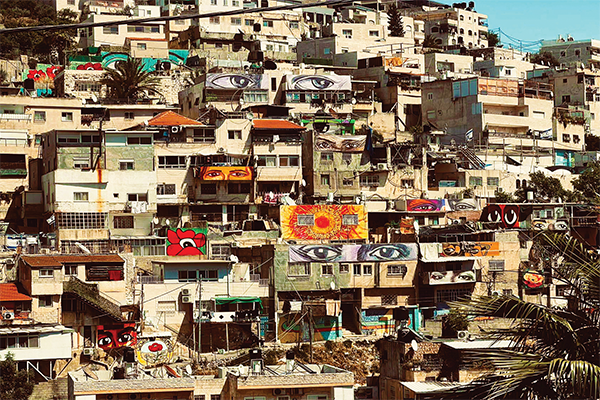
ON A HILL in occupied East Jerusalem, there’s a large mural of brown-green eyes: They are the eyes of the blind man who consented to be healed by Jesus at the Pool of Siloam, known by many locals today as Silwan pool. Silwan is a Palestinian village just outside the Old City. Painted by Palestinian artist Sliman Mansour, the eyes gaze at the pool where the biblical figure gained sight, now surrounded by soldiers with guns. He gazes at the rubble of demolished homes, surveillance cameras, children walking to school. Do you see? I felt this biblical ancestor asking me, the question hanging ripe in the tangled-wire air. Do you see?
In Silwan, Israel is building tourist sites: an archaeological park and biblical gardens. Israeli authorities and settler organizations have been working for decades to displace Silwan residents. Near Silwan pool, more than 100 homes have received demolition orders since 2005, and many have already been demolished. In December, Israeli forces tore down a four-story building.
Hundreds of people in Silwan have received eviction orders as well. Dozens have been forcibly evicted over the last several decades, some in the past few months. It’s been an ongoing battle on the part of Silwan residents to fight these demolition orders and forced evictions. What’s happening in Silwan is part of the larger story of occupation in East Jerusalem: Thousands of Palestinians have already been expelled and replaced by settlers.
In response to the forced displacement, local and international artists started painting eyes—“gazing eyes, eyes that make you question why they’re there and what’s the purpose behind them,” said one artist, who wished to not be named. The murals are part of a public arts project called “I Witness Silwan,” which began in 2015. Colorful and piercing, the eyes do not blink.
In response to the forced displacement of Silwan residents, local and international artists started painting eyes.
I saw the murals last fall when I went to the West Bank with a delegation of writers and journalists hosted by Sabeel, a Palestinian Christian liberation theology center. Two artists walked us through the neighborhood. We met at a half-demolished house where someone had painted orange sunshine on the wall, next to a quote from poet Mahmoud Darwish: “My homeland is not a suitcase, and I am not a traveler.”
Other murals included the eyes of journalist Shireen Abu Akleh, peace activist Rachel Corrie, Black Power leader Malcolm X, and Eyad al-Halaq, an autistic man who was killed by Israeli police in 2020.
“Art is a tool of resistance,” one artist told us—a “peaceful and silent but really well-spoken tool of resistance, because we speak through our murals.”
When Jesus gave the blind man sight, he spit in the mud, rubbed it on his fingers, smeared it across the man’s eyes, and told him to wash in the pool. While homes are demolished and families are forcibly evicted, he sees them—mud and sun still stinging his eyes. He consents to see the truth, to hear a human voice.
Budour Hassan, a Palestinian journalist and human rights researcher who is blind, spoke with our group about the importance of remembering those in Gaza. “Bearing witness is a burden; it’s both a physical, emotional burden,” she said. “I think that’s the least we can do, to continue to bear that burden.”

Cassidy Klein is a journalist, writer, and editor based in Chicago. Find her work at cassidyrklein.weebly.com.
Did this article have an impact on you? Tell us how! Whether you’re moved to take action, have a question, or want to share a comment (good or bad), we value your feedback!