Arts & Culture

IN WHISTLING IN the Dark: A Doubter’s Dictionary, Frederick Buechner writes of the power of art, “If we are to love our neighbors, before doing anything else we must see our neighbors. With our imagination as well as our eyes ... like artists, we must see not just their faces but the life behind and within their faces.” All art can be a sacred space to share an artist’s experiences and needs. At its very best, it can generate empathy and healing.
In the new Netflix documentary Procession, filmmaker Robert Greene works with adult survivors of sexual abuse by Catholic priests, as well as trauma-trained advocates and therapists. The six men featured in the film collaboratively create dramatic scenes to process physical, emotional, and spiritual traumas. Their journey highlights the value of supportive communities, and the restorative potential of creative expression.
Though directed by Greene, Procession is credited as “a film by” everyone involved. Top billing goes to the men whose stories the film highlights: Joe Eldred, Mike Foreman, Ed Gavagan, Dan Laurine, Michael Sandridge, and Tom Viviano. While Greene may be the one behind the camera, ownership of the film belongs to the subjects.
FOUR DECADES AGO, when I was a young editor at Sojourners, Daniel Berrigan wrote a poem for a special edition of the magazine. The note accompanying it read: “Here’s the poem—my first on a word processor. Seems a bit jumbled. Might have got a food processor by mistake.”
Berrigan has been described often as poet, prophet, and priest. The note reveals another alliterative trio that marked his life: humor, humility, and hospitality. Though I never saw him use a food processor, over the years I enjoyed several delectable dinners he whipped up in his apartment in New York City and his cottage on Block Island, accompanied by his droll wit. Berrigan was engaged in an unflinching, lifelong facedown with the world—observing its worst inhumanities and fully understanding its unlimited capacities for destruction—but he also knew how to be tickled by joy.
Bill Wylie-Kellermann is among those in Berrigan’s close circle who feasted regularly at his table, drawing sustenance from the food, lively conversation, and prophetic insights. Celebrant’s Flame: Daniel Berrigan in Memory and Reflection (Cascade Books) is Wylie-Kellermann’s moving tribute to the man who was first his professor, then his mentor, and ultimately his beloved friend. It is a treasure trove of poems and letters, sermons and speeches, reflections and court testimonies, even a seminary paper—a patchwork sewn into a beautiful whole.

Despite the discomfort some viewers might feel from the film’s visceral violence, Nightmare Alley is ultimately an old-fashioned morality tale, one in which del Toro refuses to let his central character escape the weight and judgment of his own actions. The film barrels towards the moment when Stan’s schemes fall apart with unrelenting brutality, and eventually Stan’s machinations begin to unravel. Nightmare Alley also thrills in the strong performances of characters: Cate Blanchett’s Dr. Lilith Ritter, cool and unflappable, always in control even when she seems not to be; Toni Collette’s Zeena, whose love is more complex than it initially appears.
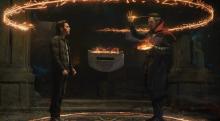
Spider-Man: No Way Home is the end of a lot of things. It's the end of the (first) Marvel Cinematic Universe Spider-Man trilogy. It’s the end of a lot of speculation about how the multiverse will play into the MCU’s future (since the Loki TV show broke it open). But it also signals the end of the MCU’s innocence — and by extension, superhero movies in general. Spider-Man: No Way Home insists that true heroism looks markedly different from what superhero movies have offered thus far.

On Dec. 14, siblings Bekah, Caleb, and Joshua Liechty, collectively known as Girl Named Tom, became the first group to win NBC’s The Voice after 20 seasons of solo winners. In a blind audition, the siblings delighted the four celebrity coaches with their tight harmonies, but each of the three got a chance to shine throughout their performances. With the enthusiastic support of their coach, Kelly Clarkson, the trio presented new arrangements of beloved classic rock, country, and folk hits.
The Liechty siblings grew up attending Zion Mennonite Church in Archbold, Ohio, and brothers Caleb and Joshua are graduates of Goshen College, a Mennonite college. While Bekah and Joshua, who spoke with Sojourners, consider their faith identity to be “in exploration,” they continue to be rooted in Mennonite community.
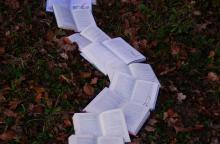
Novelist Edwidge Danticat expressed a similar sentiment in Create Dangerously, her 2010 memoir about making art in exile. Reflecting on the aftermath of the earthquake that had struck her home country of Haiti that year, she wrote, “I did what I always do when my own words fail me. I read.” We share this human practice of story sharing and story seeking. Danticat writes of her “desire to tell some of [her] stories in a collaged manner, to merge [her] own narratives with the oral and written narratives of others.” Through the transformative power of creating and remembering, we connect to the threads of humanity, discovering the woven patterns that are formed through our stories.
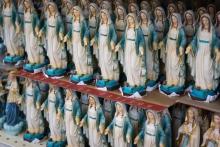
During this Advent season, Sojourners has featured a heavy dose of Mary-oriented stories. As a Protestant, I was taught, similar to Amar Peterman, that we should “be wary of those who spoke of Mary ‘too much.’” But what’s so scary about Mary? Some evangelical Protestants say the reason we should be leery of revering Mary is because if we honor her too much, our faith becomes a cult.

When I met bell hooks three years ago, I had all four of my children in tow and I wasn’t sure what to say. A mutual friend arranged a short visit to her home. My heart was bursting with gratitude for all the ways hooks wove race, gender, class, faith, place, and love into her work. My mind was racing with ways to express some fraction of my appreciation and awe.
In season two of Ted Lasso, our favorite stubbornly positive coach struggles with anxiety. Unfortunately, the king of talking-it-out doesn’t initially trust talk therapy. In an uncharacteristic display of disrespect, Ted — who doesn’t want to dig up his past traumas — calls the work of the team’s sports psychologist, Dr. Sharon Fieldstone, “bullshit.” Somehow, Fieldstone keeps her cool. “I can’t be your mentor without occasionally being your tormentor,” she tells Ted.

Did you know jazz musician John Coltrane was canonized by the African Orthodox Church in 1982? Coltrane was canonized at the behest of a religious community in San Francisco which founded a church in his name, and St. John Coltrane Church is still alive and well today.

Spencer is the ultimate I-won’t-be-home-for-Christmas film. It is Black Swan meets Jackie meets (to a far lesser degree) the The Family Stone. Which feels poignant in 2021, a year in which many of us are afraid to go home. The omicron variant will undoubtedly keep some of us away from our families. But others who can travel home for Christmas may feel anxious about the prospect of returning to houses divided by politics, theology, misinformation, or all three.

“Above all else, guard your heart,” warns Proverbs, “for everything you do flows from it” (4:23). But can any of us say we’ve made it through the past few years with our hearts in good repair?
Yet whenever I’d crack open a book, something stirred; stories have a way of seeping in where tweets, memes, and news alerts fail.
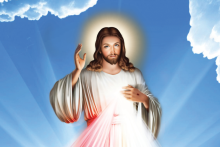
“Yassification” is a recent meme spreading across social media. To “yassify” something is to heavily edit the original image with multiple filters until the figure is blurred, airbrushed, and entirely unrecognizable. Many of these images come from Twitter user “@YassifyBot,” who primarily yassifies famous paintings, actors, and politicians. Religious leaders, however, are not immune from yassification: Pope Francis, Martin Luther, and Joan of Arc have all been yassified. Anyone can be yassified these days — even Jesus.

The Parkers wanted to limit small talk at their annual family Christmas party, fearful that conversation would veer into politics, or religion, or whether Pete Davidson is unconventionally attractive. So they organized a harmless white elephant gift exchange. By night’s end, they would be full of carbs and regret, vowing to play charades next year.

A lot of people I admire are fascinated with Hallmark Christmas movies. Chief among them is Mariame Kaba, founder of Project NIA, a leading advocate of prison abolition, and a self-described “Hallmark Channel devotee.” “I love the anthropological whiteness of those films,” Kaba told public radio in 2018. “I’m pretty sure there are white people who live like that. I don’t know any of those white people. I find it fascinating for that reason.”

My favorite part of Thanksgiving is the leftovers. If we’re being honest, most of the food tastes better the day after the feast. Cranberry sauce becomes a sandwich spread, ham goes into a breakfast taco, bones go into a pot to make enough broth for several weeks of soup. Some happenings are so big that there’s always much leftover.
But not all leftovers are good. Trauma, for instance, can linger for months or years after the initial act of violence.

Even with the mass upheaval of our societal patterns and expectations brought by the pandemic, and the spread of global protests against racism and police brutality, our material conditions are not changing at the pace of our rhetoric.

I am the angel who heard their euphony:
the Hebrew prophet’s words turning to
lamb
topaz on Ethiopian tongue, their voices
wedded together, gleaming
knife
beneath the desert sun. Imagine it:
you are Qinaqis, born beside
ewe
the Gihon River that once flowed from
Eden, marked for exile
mute
from family, from choice,
from even the faith
sheared
you one day will embrace,
despite your pilgrimage through
torment
the wilderness.

AS WE APPROACH the new year, the more fortunate among us will be taking time to organize their lives by rebalancing their financial portfolios and considering new investments. While taking care of your cash, it’s important to remember that a wise teacher once said, “Store up for yourselves treasures in heaven, where moths and vermin do not destroy.” I still don’t know what vermin is (it’s probably bad because it’s in the same sentence as moths), but I think the teacher might have been telling us that in additionto tending to our finances, we should also tend to our spiritual portfolios.
If you’re wondering about how exactly to do this, here are three rules to spiritual wealth that I think will prove helpful.
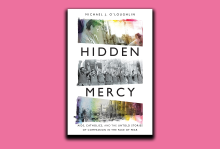
AFTER TWO YEARS of COVID-19, the world yearns to move forward. Meanwhile, we commemorate 40 long years of the HIV/AIDS epidemic in the U.S. The first years were characterized by silence, as government, churches, and other institutions generally ignored people living with HIV and dying from AIDS. However, compassionate individuals broke the silence and offered care and advocacy. In Hidden Mercy: AIDS, Catholics, and the Untold Stories of Compassion in the Face of Fear, Michael J. O’Loughlin gives voice to Catholics who followed the gospel call to serve these marginalized in the U.S. in the 1980s and ’90s.
Hidden Mercy, based on the podcast series Plague: Untold Stories of AIDS and the Catholic Church, focuses on the experiences of a few individuals—including a nun in the Midwest, a gay artist priest, and a lay Catholic nurse. One championed the first public HIV/AIDS education program—notably held in a Catholic church. Others advocated for hospital beds for HIV patients, established hospice homes, or ministered to the homeless and persons of color, who were—and still are—disproportionately affected by HIV/AIDS. They facilitated pharmaceutical clinical trials that included persons of color. Others led interfaith memorial services. These Catholics ministered to the sick while the institutional Catholic Church was first silent, later insensitive, and at times heartless in written and verbal statements targeting gay people with HIV/AIDS.