
Eliza Alemán is a reporter in the Spring 2026 Sojourners Journalism Cohort.
Eliza was born in Rock Island, Illinois, and raised in southwest Florida. Growing up in diverse communities, she developed a passion for social and environmental justice at a young age. Eliza is the proud descendent of Mexican farm laborers and believes in the power of America’s working class. As a rising graduate of Goshen College, and a former executive co-editor for the college’s newspaper, she found her niche in journalistic reporting. In her spare time she likes finding new ways to cook chicken, binge watching adult cartoons and reading up on gender history. She finds hope for the future and connection with God through the natural world.
Posts By This Author
What Connects ICE Resistance and Anti-Zionism? These Mennonites Can Tell You
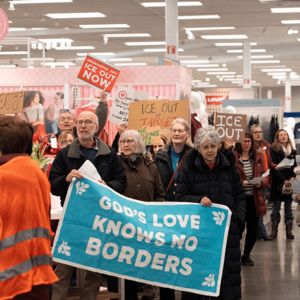
When Mennonite Action formed to oppose the U.S. support for Israel’s occupation of Palestine, they never imagined they’d soon be opposing occupation in their own backyard. As federal immigration forces descended on Minneapolis and other cities across the nation, Mennonite Action worked to defend their neighbors, oppose unjust immigration policy, and educate Anabaptist participants on the connection between Christian Zionism and Christian Nationalism.
Since establishing itself with just seven volunteers meeting virtually, Mennonite Action has grown to five paid staff members, four volunteer leaders, and now holds national leadership retreats annually. After its November 2024 retreat following the presidential election, the group felt that public action against new immigration enforcement would be necessary. Sarah Nahar, the staff supervisor and a member of the Mennonite Action steering committee, said the leadership team and staff worked on solidifying organizational language while remaining steadfast in their commitment to public action in support of Palestinians.
“There are deep, intertwined mechanisms of power and oppression operating in the U.S.-Israeli occupation of Palestine, and many of us in the room knew that,” Nahar said. “One of the things that we worked really hard to do in that meeting was to talk about how this wasn’t a transition or a shift.”