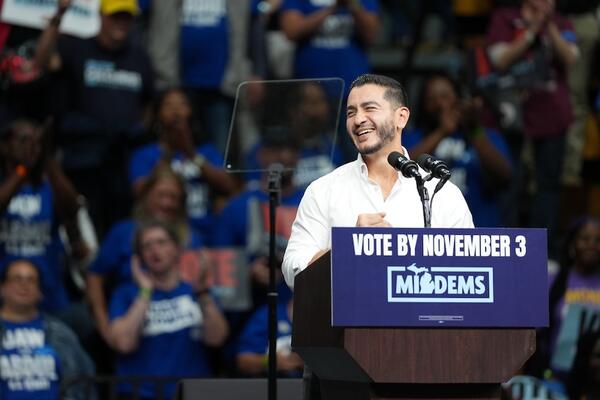
Last week at a town hall event in Caro, Mich., a heckler lobbed Islamophobic accusations at Democratic Senate candidate Abdul El-Sayed.
That’s unfortunately unsurprising this cycle, as Republicans, panicked by a growing Democratic wave, have doubled and tripled down on bigotry. But what made this incident go viral is the way in which El-Sayed calmly turned the accusations around and demonstrated the extent to which Republican hatred of Muslims is rooted in an exclusionary Christian nationalism.
As reported by independent journalist Marisa Kabas, the heckler at El-Sayed’s town hall was Thomas Teepell, a former aide to Missouri Republican Sen. Josh Hawley and son of Republican strategist Timmy Teepell. In what appeared to be an attempt to embarrass and smear El-Sayed, Thomas Teepell—who goes by Tommy—stood up and framed a demand as a question: “I have one simple question: Will you disavow the Muslim Brotherhood?”
After El-Sayed said he “absolutely” disavowed the Muslim Brotherhood, he asked Tommy a question of his own: “What are you implying? Do you assume that I wouldn't?” After some back-and-forth, El-Sayed makes his point: “You assume, Tommy, that because I am Muslim, that somehow I would have some allegiance to something that is not our Constitution. That's your assumption. That's implicit in the question.”
El-Sayed noted that this was the same logic and prejudice that had led people to question whether President John F. Kennedy, the first Catholic president, would have allegiance to the pope. El-Sayed said it was important to home in on Tommy’s question because Tommy asked it in such a way as to suggest “that somehow our Constitution shouldn’t be the thing that all of us bear allegiance to. And I’m just telling you,” El-Sayed continued, “that for me, that Constitution is the guiding light. It guarantees me the right to pray as I choose to pray or not pray at all.”
El-Sayed then asked Tommy which religion he practiced. Tommy said he was a Christian. El-Sayed then explained that he wanted to protect Tommy’s right to practice his faith because that’s what the Constitution guarantees. “[I]t seems like you don’t want to protect my right to practice as I choose to,” El-Sayed said. “So, I’m going to ask you: Do you disavow any attempt to read any religious doctrine into the laws of our country?”
“I do not,” Tommy replied.
“So, I think it’s you who needs to understand the Constitution, not me,” El-Sayed concluded.
It’s clear that Tommy believes that the Constitution is and should be influenced by his own vision of right-wing evangelical Christianity. He’s hardly alone; Trump has notoriously appointed right-wing Christian nationalists like Defense Secretary Pete Hegseth and head of the White House Faith Office Paula White-Cain. Hawley, Teepell's former boss, gave a 2024 speech to the National Conservatism Conference titled, “The Christian nationalism we need.” And beyond that, as journalist Katherine Stewart explains, “[the Christian nationalist] movement is driving policy, whether or not the people who are pushing that policy identify themselves as Christian nationalists or adhere to Christian nationalist ideas.”
The movement Teepell represents is nationalistic and authoritarian insofar as it insists on rejecting the separation of church and state, and demands that non-Christians live under the rule of ultraconservative Christians. Zionists (Jewish and Christian) have attacked El-Sayed’s campaign, insisting that his opposition to Zionism means that voting for him would be “giv[ing] up our ability to define ourselves as a Jewish people,” according to one critic. But El-Sayed’s defense of the Constitution and his interlocutor’s refusal to do so, make it clear that it is the current Republican Party and its Christofascist base that do not respect the identities of Jews, atheists, Catholics, or people of any other religion.
When Christians with close ties to senators and the Republican Party assert that U.S. laws should have a Christian bias, this is ominous for Muslims, Jews, and anyone who does not practice the narrow version of Christianity that is increasingly influencing our politics.
The charge of dual loyalty, as El-Sayed points out, has been used against a wide variety of religious minorities. It has notoriously been used against Jewish people, who are often charged with being clannish outsiders constantly scheming to betray their neighbors.
President Donald Trump references this kind of dual loyalty when he insists that Jewish people who vote for Democrats rather than for him are guilty of “great disloyalty” and that they “hate their religion.” For Trump, Jewish people’s real loyalty is, and should be, to Israel—and to him, since he is “a friend and lifelong supporter of Israel.” For Trump, the idea that Jewish people might be Americans in their own right or have an American identity that eschews loyalty to Israel or to him is unimaginable.
READ MORE: Christians, Islamophobia Is Our Problem
The dangers of Christian nationalism to Jewish people get short shrift in public discussions of antisemitism because the media and many Jewish institutions focus on opposition to Israel as the one true sign of antisemitism. Zionist organizations and politicians (Christian and Jewish) have a great deal of institutional clout and substantial funding, and that can make it seem to Christian and Jewish people alike that Jews see opposition to Israel as more dangerous than Christian nationalism. Christians may come to think that solidarity with Jewish people necessarily entails solidarity with Zionism—a conclusion that erases Jewish anti-Zionists and critics of the alliance between Christofascists and supporters of the state of Israel, such as myself.
Jews do largely recognize that there are direct practical effects for Jewish people when Christianity is viewed as supreme and uniquely American. For example, many Jewish people believe that access to abortion is a core part of their religious identity and beliefs. But the Christian Right has led a successful campaign to prevent abortion access, thereby violating Jewish religious liberty and endangering the lives of Jews—which is what they are accusing El-Sayed of doing. When the Trump administration legalizes and encourages Christians to proselytize in the federal workplace, it is permitting Christians to harass Jews and other non-Christians, and even many Christians. Again, El-Sayed is not the one promoting these laws and memos; it is instead people like Tommy and the Republican Party.
In Michigan, the Republicans have gone all in on winning Jewish and Christian nationalist votes through flagrant displays of Islamophobia. Republican Senate candidate Mike Rogers has claimed (falsely) that El-Sayed is “close to the people who are supporting the Muslim Brotherhood.” Trump has lied and said that El-Sayed is “100%” a member of the organization.
El-Sayed opposes military aid to Israel, a nation that has been committing a genocide against Palestinian people, according to genocide scholars. Some people—both Jewish and Christian—disagree with El-Sayed’s stance and may vote against El-Sayed as a result.
But the openly bigoted rhetoric of Tommy Teepell, Rogers, and Trump underlines why that would be a bad choice for Jewish people. German pastor Martin Niemöller famously wrote that when the Nazis came for Jews and Communists, he did nothing because he was neither a Jew nor a Communist. By the time he realized his error, there was no one left to speak out against the Nazis.
El-Sayed, in his town hall, spoke out for himself. But he also spoke out for all religious and ethnic minorities facing a Republican Party that has embraced Christofascism. If Christian nationalists are allowed to define America as a Christian country in which Muslims are viewed as alien outsiders, it won’t be long until Jews, Catholics, atheists, and anyone expressing political dissent will also be labeled as alien outsiders. If we want a Constitution that allows for religious diversity and political dissent, we need to reject Islamophobia and those like Tommy Teepell who spread hate.
If Christian nationalists are allowed to define America as a Christian country in which Muslims are viewed as alien outsiders, it won’t be long until Jews, Catholics, atheists, and anyone expressing political dissent will also be labeled as alien outsiders.
Noah Berlatsky (he/him) is a freelance writer in Chicago. His poetry collection Not Akhmatova (Ben Yehuda Press) addresses the Jewish diaspora. His newsletter is Everything Is Horrible.
Did this article have an impact on you? Tell us how! Whether you’re moved to take action, have a question, or want to share a comment (good or bad), we value your feedback!