Subscribe and Get Our New Book Subscribe

Faith Leaders Share Why They Joined Zohran Mamdani’s Transition Team

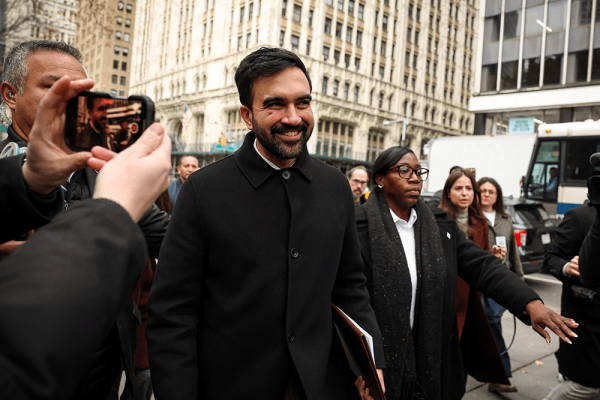
New York City Mayor-elect Zohran Mamdani exits a press conference at City Hall Park in New York City, Nov. 20, 2025. REUTERS/Brendan McDermid

As Zohran Mamdani prepares to take the New York City mayor’s office, he’s tapped several NYC faith leaders to work on his transition team, centering affordability and day-to-day needs of New Yorkers.

Mamdani’s election was one of the most successful in recent memory. Mamdani, who entered the race as a relatively unknown upstart, defeated former Gov. Andrew Cuomo in a primary and general election—becoming the first candidate since 1969 to earn over one million votes. Over a month after Mamdani’s victory, much of the excitement behind his campaign has yet to waver.

Mamdani’s transition team, made up of 17 advisory committees and more than 400 people helping to advise his incoming administration, received more than 50,000 applications. Among those selected to facilitate his transition are at least 18 faith and religious leaders from a range of traditions.

Of the Christian leaders listed, the denominations represented include Baptists, Seventh-day Adventists, and Episcopalians, spread across committees focused on housing, youth and education, and community safety. Those faith leaders told Sojourners they looked forward to working with the Mamdani administration. They hope to share how faith communities already work to address New Yorkers’ needs and improve collaboration between their organizations.

Rev. Rashad Raymond Moore, pastor at First Baptist Church of Crown Heights, who serves on the Committee on Youth and Education, was invited to his position to help address the concerns of affordability that have been gripping the city.

“‘Affordability’ may be the buzzword of the moment, but New Yorkers need more than language – they need leadership, land, and long-term investment,” Moore told Sojourners over email. “Moving from slogans to shovels will require the organizing power of faith communities who have already proven we can build at scale.”

Moore hopes that the Mamdani administration will build on these relationships and will perceive faith communities as “strategic builders” instead of “symbolic stakeholders.”

“Faith communities are woven into the fabric of New York,” he wrote.

He referenced the work that East Brooklyn Congregations and the Metro Industrial Areas Foundation—two members of interfaith, community-based organizing groups—have done to help build “thousands of affordable homes in East New York.” These groups hopes to continue these efforts on “city-owned, state-owned, and congregational land” as proof of the organizing power churches have.

Rev. Charles O. Galbreath of Clarendon Road Church, who is serving on the Committee of Community Safety, also cited the urgent needs of New Yorkers as his reason for joining Mamdani’s transition team.

Galbreath particularly listed challenges concerning “housing, affordability, food insecurity, and immigration” as some of the most pressing issues facing his community.

“Faith leaders have already been doing this work,” Galbreath said. “[Mamdani] hears this directly [and] echoes the needs and concerns of our communities.”

He lauded Mamdani for reaching out and cultivating relationships with faith leaders, saying Mamdani is “not a lobbyist for the rich.”

Beatriz de la Torre, chief philanthropy officer at Trinity Church Wall Street and who is serving on the Committee on Housing, echoed a similar sentiment in an email to Sojourners.

“The faith community speaks on behalf of all people without regard for their politics,” de la Torre wrote. “That mission is helped by our natural relationships with a vast web of nonprofit organizations in the city who are already doing essential work in addressing these problems on a day-to-day basis.” 

De la Torre, who was selected to join the transition team due to her background in housing and homelessness issues, repeated many of the same concerns as Moore and Galbreath, but homed in on the potential of faith communities to help remedy this strife. 

“Faith leaders care for the forgotten every day,” de la Torre wrote. “No matter the issue, faith leaders are already doing the work and can help bring people together to find shared answers.”

She is hopeful that the Mamdani administration will tap into this potential to work toward bettering the lives of all New Yorkers.

“I believe the incoming administration has a real opportunity to work closely with faith organizations to restore the dignity of the individual in our city at a time when many are struggling with ideas of basic survival,” she said. “I am inspired by the Mamdani team’s focus … and I believe working with faith organizations like Trinity Church offers a natural path forward.”

“Faith leaders have already been doing this work. [Mamdani] hears this directly [and] echoes the needs and concerns of our communities.” —Rev. Charles O. Galbreath of Clarendon Road Church