Chicago Is in a State of Holy Rage

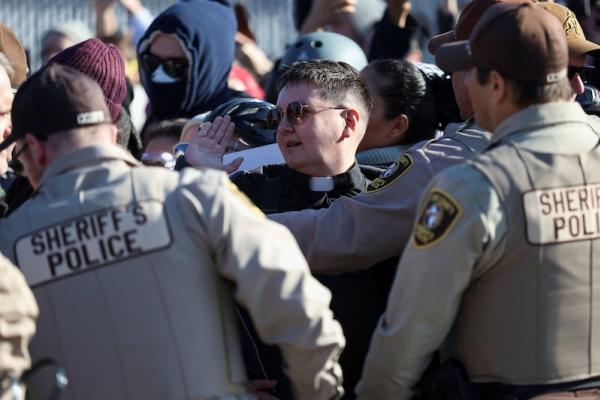
Faith leaders clash with Illinois State Police during a protest against immigration actions, outside the Broadview ICE facility in Broadview, Ill., Nov. 14, 2025. Credit: Reuters/Jim Vondruska

Chicago is in a state of holy rage. Last Friday morning, I stood with many of my colleagues in ministry at a multifaith service outside the Immigration and Customs Enforcement processing facility in Broadview, Ill. It would be better to call this facility an abduction center, as those who are detained there have little to no contact with the outside world. ICE officials have prevented clergy from entering the facility to offer pastoral care and even the Eucharist

Before we made our peaceful attempt to enter the facility, we held a service and created an altar. There, we placed items that are currently being denied to our beloved siblings inside the facility: toothbrushes, toilet seats, bottled water, soap, towels, rosaries, telephones, and bread—symbols of basic human dignity.

After placing each item on the altar, we shouted together, “God demands freedom!” We then sang a protest song: Tear down the walls, tear down the walls at Broadview. We ended this beautiful time together by playing the shofar, which is a Jewish ritual that announces God’s presence and affirms that the walls of oppression will be brought down.

As we sang, prayed, and shouted, I looked around at so many familiar faces, many of whom had been moved to tears. These were faces I had sat with in dusty church basements over bad coffee to plan ecumenical Thanksgiving services; faces I had organized with in interfaith spaces to ensure our neighbors’ needs were met; faces I had called when desperately seeking resources for a congregant who was in trouble; faces that had shown up for me and my people.

Not 10 minutes later, I saw many of those same faces bloodied and shouting, as the Illinois State Police knocked them to the ground and dragged them away to be arrested. I was tasked with leading chants, a task I had done many times before, but I found myself overwhelmed with a seemingly bottomless rage as I watched the police brutalize my colleagues. I took a step back as hot tears formed in my eyes. If state police were willing to do this to my colleagues in clerical collars in broad daylight in front of dozens of media cameras, what kind of violence was the U.S. Empire exacting on the vulnerable behind the walls of this abduction center?

The church doesn’t often know what to do with holy rage. Too often, discipleship has failed to take our call to justice seriously. We conflate being a Christian with being “nice,” or being “civil.” But Jesus was not civil, and Jesus was not always nice. The God who is angered by injustice in the psalms, the Christ who turns over the tables of exploitation in the temple, the Spirit who comes as a rushing fire, burning but not consuming—these are our examples for holy rage. God is always angry on behalf of the oppressed. Holy rage is what we feel when the powers and principalities of this world work against the world as God would have it. God feels our rage.

Holy rage is what we feel when the powers and principalities of this world work against the world as God would have it. God feels our rage.

READ MORE: ‘Put Your Soul on Your Hand and Walk’ Is a Must-Watch Documentary

Since the immigration crackdown in Chicago began in September, I have had parishioners say to me, “I didn’t know my body could hold this much rage, and it scares me.” How could we not feel this rage, after watching children zip-tied in the middle of the night, teachers kidnapped from their workplaces, and fathers killed by law enforcement? And that holy rage is reserved for only the things we know about. What about the beloved neighbors who quietly disappeared from our pews and workplaces without any transparency about where they were taken? Holy rage is not only the right response to this moment, it is the only faithful response.

Our authoritarian government is pouring millions of dollars into abducting, torturing, and murdering people they label as immigrants or terrorists. Our rage means that, for as hard as President Donald Trump and his administration are trying, they have failed in intimidating us or convincing us that what’s happening is normal. And there is Holy Spirit power in that. In fact, scripture tells us to be angry. Ephesians 4:26 says, “Be angry, but do not sin . . .” How can we be angry without sinning? What are the guardrails for that?

Here, life is an excellent moral teacher. Anger that is turned toward the vulnerable and the oppressed makes us small and mean and ugly. It diminishes us. I imagine that it is this type of anger that motivates U.S. Border Patrol Chief Gregory Bovino and his agents in their racist attacks on American cities. This rage is pointed at the most vulnerable, and it requires those wielding the anger to disconnect from the reality of their humanity and the humanity of others.

The rage we are called to as people of faith is rage with the vulnerable and the oppressed, rage with those who have God on their side; it is a rage that follows Jesus into the temple to overturn tables. This rage is a collective effort, and it connects us more deeply to our humanity and to our neighbor. It says we will not become numb, we will not believe the lies we are told about immigrants. Instead, we will stay connected to the truth and reality that all people are made in the image of God, and the body of Christ is not complete without our immigrant neighbors.

Chicago is in a state of holy rage, and we will not bow to fear. Of course, we feel other things in this struggle too: joy, love, solidarity, sadness. But the holy rage we feel is a call to action. And to those who are now facing these racist attacks, wondering what to do with their rage, I say this: Let it make you brave, let it bring moral clarity, and let it build solidarity because we know that God is always on the side of the oppressed and God demands freedom.