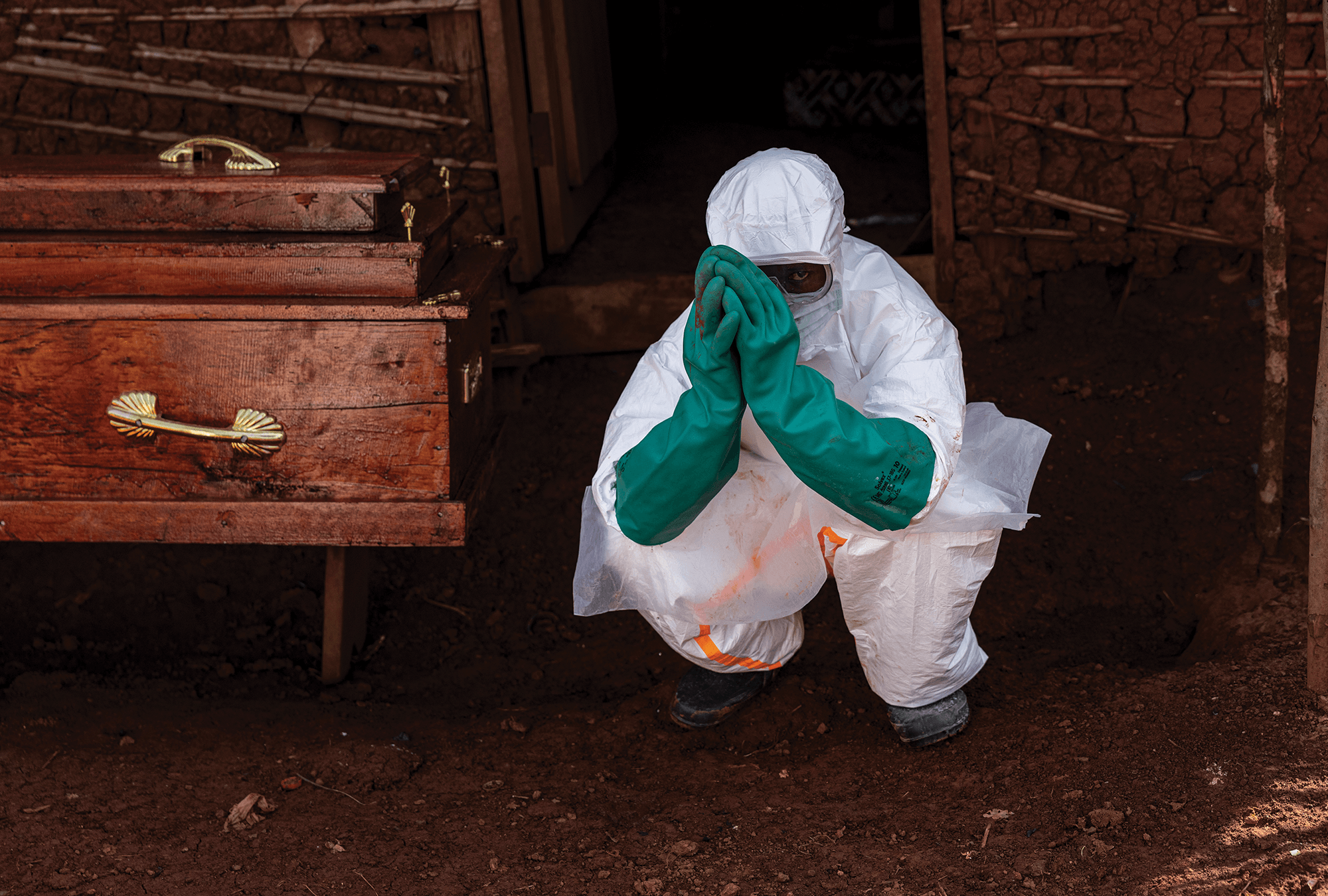
A health worker crouches beside the coffin of a suspected Ebola victim during safe burial procedures outside a family home in Mongbwalu, Ituri Province, Democratic Republic of Congo in May 2026. Reports indicate more than 1,000 cases of the Ebola virus and 300 deaths have occurred this year, with actual numbers likely higher due to instability in the region that makes tracking and treatment difficult.

How We Build Trust and Prevent the Spread of Ebola

Working toward social cohesion and against misinformation.
By George Wanyu Ndikintum

WE WORK WITH vulnerable and displaced populations by bringing community members together. Our activities usually require people to be in close contact. Social cohesion is not only verbal, it’s also physical. With the outbreak of Ebola, a deadly virus spread through contact, especially through human fluids, we have been forced to reduce the number of people we work with. Some communities think Ebola was invented—that it is not real. There is resistance to prevention measures for Ebola. When a community does not accept that Ebola is real, we get influential, trusted community members, youth, and women’s organizations to understand and relay their message to the wider community through social media or in small one-to-one communications.

The people in Eastern DRC are human beings, and communities are suffering. We are really engaged to make sure communities are not contaminated. We will not want to see people lose their lives because of misinformation. If you come tomorrow, they’ll say, “You abandoned us when we were in danger.” So that is why we are motivated to keep close contact. When I say close contact, I mean close communication.

During this period, it has been very difficult for humanitarians to travel because several borders are closed. Humanitarians actually need rest and relief ... to go for rest and come back refreshed to continue their job. Because in these times, communities need humanitarians. And if they get stressed and tired, they will not be able to deliver the services in the context in which they are working.

This appears in the August 2026 issue of Sojourners

George Wanyu Ndikintum spoke with Sojourners associate editor Josina Guess.

George Wanyu Ndikintum manages a consortium of organizations promoting stabilization and social cohesion in Ituri, Democratic Republic of Congo.